

Imagine it’s a typical Tuesday afternoon in Mount Pleasant, and the humidity is thick enough to feel. You walk inside expecting a blast of relief, but instead, you’re met with a puff of lukewarm air. It’s an immediate sinking feeling, especially when you realize you need a reliable ac blowing warm air fix before the house becomes unbearable. We know how stressful it is when your home stops being a sanctuary from the Lowcountry heat. You start worrying about complex jargon, or worse, being overcharged for a repair you might not even need.
It’s completely normal to feel a bit overwhelmed when the vents stop cooperating. However, many cooling issues are simpler than they first appear. We’ve put this guide together to help you regain control over your indoor climate without the stress. You’ll learn how to troubleshoot the most common causes of warm air, identify which tasks you can safely tackle today, and understand when the situation requires an expert’s touch. We will walk through everything from thermostat glitches to airflow blockages, giving you a clear path back to a cool, comfortable home.
Key Takeaways
- Learn the immediate steps to take, like checking your thermostat settings, to find a quick ac blowing warm air fix and protect your system from mechanical strain.
- Discover why issues like frozen evaporator coils or refrigerant leaks happen even in the peak of a South Carolina summer.
- Understand how simple maintenance on your outdoor condenser, such as clearing debris and rinsing away salt air, can restore cooling efficiency.
- See how local humidity and coastal salt affect your AC’s longevity and why your system acts as a giant dehumidifier before it can cool your home.
- Identify the specific “no-go” repairs involving high-voltage wiring or refrigerant that require a professional to ensure your safety and long-term cost savings.
Immediate Steps: Triage for an AC Blowing Warm Air
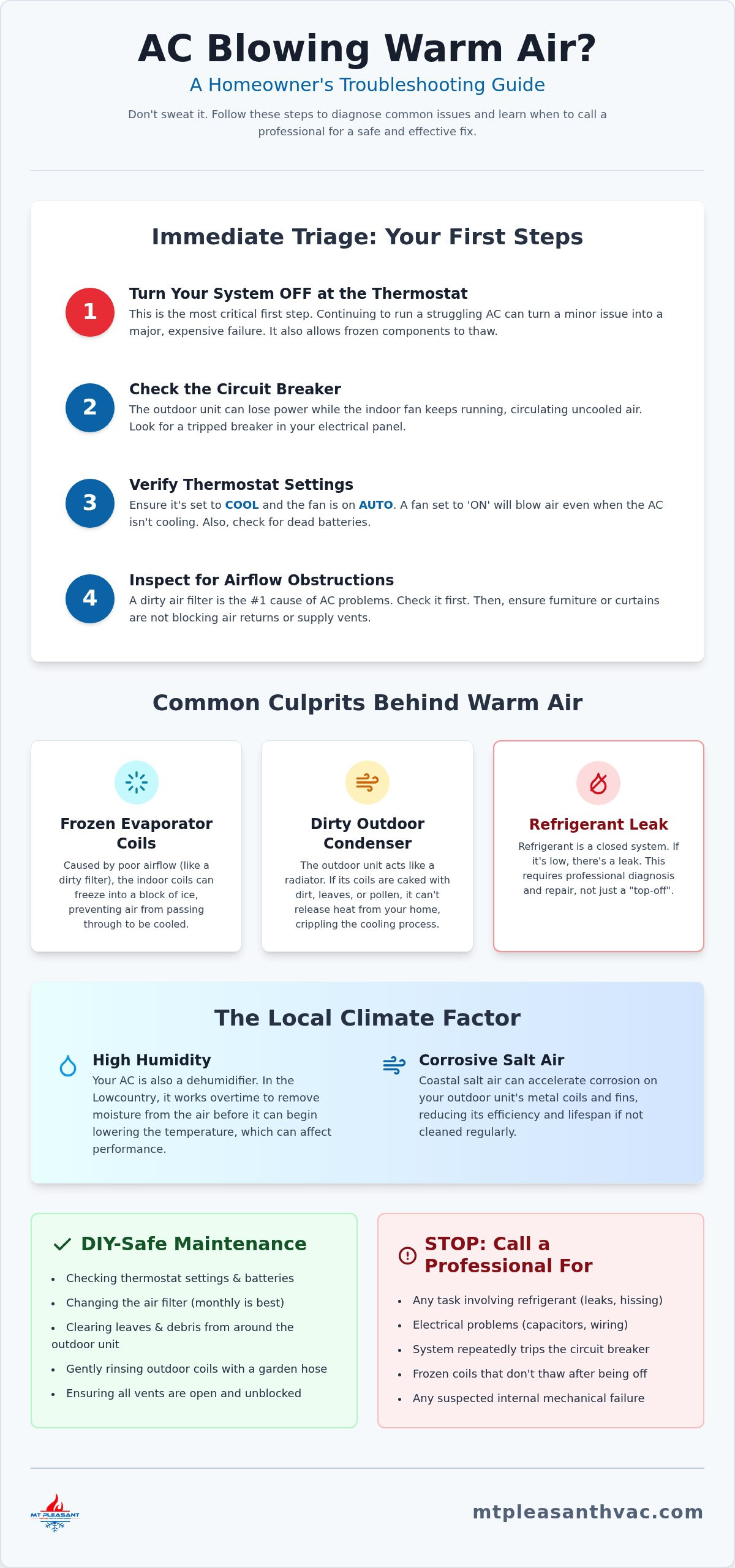
Is your living room suddenly feeling more like a humid afternoon on the porch than a cool sanctuary? Before you start worrying about the cost of a major repair, take a deep breath. The first and most important step for an ac blowing warm air fix is to switch your system to ‘Off’ at the thermostat. If your air conditioner is struggling with a mechanical issue or a frozen coil, continuing to run it will only cause more strain. Giving the system a rest prevents minor issues from turning into expensive motor failures while you investigate the cause.
While the system is resting, take a quick walk to your electrical panel. Has a circuit breaker tripped? Sometimes the outdoor condenser loses power while the indoor blower keeps running, leading to lukewarm air circulating through the house. If the breaker is fine, it’s time to look closer at your controls and airflow.
The Thermostat Check: Simple Settings, Big Impact
It might seem obvious, but start by verifying that your thermostat is set to ‘Cool’ and the target temperature is at least three degrees below the current room temperature. One of the most frequent sources of confusion is the fan setting. If your fan is set to ‘On,’ it will blow air through your vents 24/7. This means when the cooling cycle pauses, the fan keeps pushing uncooled, room-temperature air around. Switch it to ‘Auto’ so the fan only runs when the system is actively chilling the air.
Don’t forget to check the display itself. Is it blank or flickering? A dead battery can prevent the thermostat from sending a ‘start’ signal to your outdoor unit. If you’ve recently changed the batteries and it’s still acting up, a loose wire behind the faceplate might be the silent culprit. These small electrical hiccups are common, especially in older control units.
Airflow Obstructions: The Silent Cooling Killer
Air conditioners don’t actually create cold; they remove heat from your home. To understand the mechanics of this process, you can read more about How Air Conditioning Works. If your air filter is packed with dust, the system can’t pull enough warm air over the cold evaporator coils. This causes the coils to drop below freezing, turning condensation into ice. To check for this, look for these signs:
- Visible frost or ice on the copper lines leading to the outdoor unit.
- Water pooling around the indoor air handler or furnace.
- A noticeable drop in the volume of air coming from your vents.
Once that ice block forms, air can’t pass through, and you’re left with a warm breeze. Try the ‘hand test’ at your nearest supply vent. Does the air feel weak? If so, check every room to ensure return vents aren’t blocked by furniture or curtains. A single closed register or a dusty filter can be the difference between a refreshing afternoon and an unnecessary repair call.
Common Culprits: Why Your Home Isn’t Cooling
If your initial checks didn’t result in an ac blowing warm air fix, the problem likely lies within the system’s mechanical or chemical components. While the indoor unit handles the air, the outdoor unit is responsible for the heavy lifting of heat rejection. If either side of this equation fails, you’ll feel the difference immediately. Even in the peak of a Charleston summer, your system can actually freeze itself. When refrigerant levels are off or airflow is restricted, the indoor evaporator coil temperature can drop below freezing. This turns normal condensation into a block of ice that prevents any cool air from reaching your living space.
Your outdoor unit needs to “breathe” to stay functional. Think of the condenser coils as a set of lungs that exhale the heat gathered from inside your home. Over time, dust, pollen, and local salt air can coat these coils. This layer acts like an insulator, trapping heat inside the system. When the unit can’t release that heat, the cooling cycle breaks down, and you’re left with lukewarm air coming through the vents.
Refrigerant Issues and Low Pressure
Refrigerant acts as a chemical messenger that absorbs heat from your indoor air and carries it outside to be released. Many homeowners believe refrigerant is like gas in a car that needs occasional “topping off,” but it’s actually a closed-loop system. If the level is low, you have a leak. You might notice a faint hissing sound near the unit or see a greasy, oily residue on the copper lines. Simply adding more refrigerant without fixing the source of the leak is a temporary patch that often leads to more frustration. For more detailed guidance on identifying these symptoms, check out these Quick Fixes for Your Air Conditioner.
Electrical Failures: Breakers and Capacitors
Sometimes the issue is purely electrical. If the indoor blower is running but the outdoor unit is silent, check your electrical panel for a tripped breaker. Be cautious, though. A breaker that trips once might be a fluke, but one that trips repeatedly is a safety feature warning you that a motor is drawing too much power. This is often a sign of a deeper mechanical struggle within the compressor.
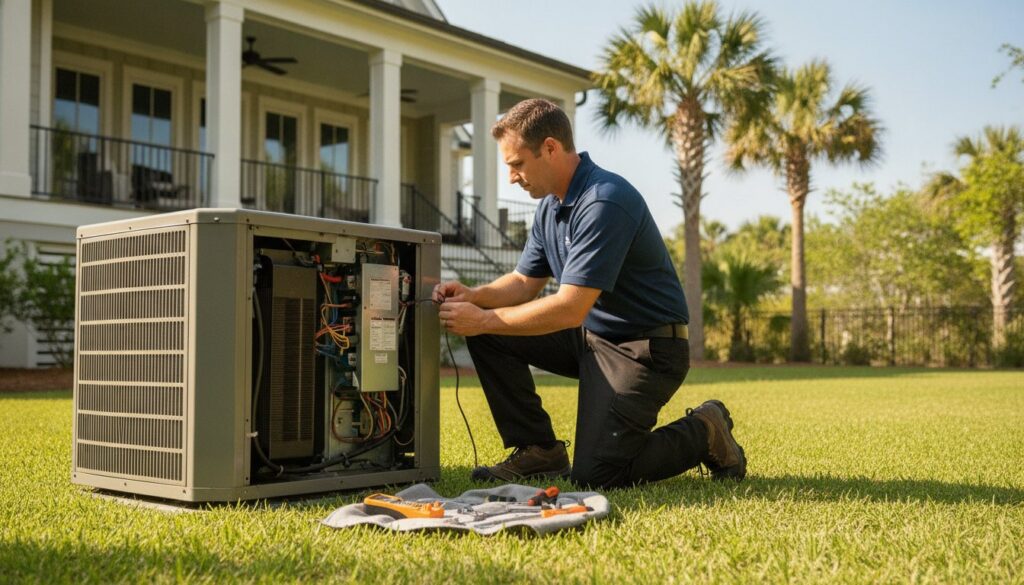
Another common failure point is the capacitor. This small, cylindrical component acts like a high-powered battery that gives the compressor the “kick” it needs to start. During a hot South Carolina summer, these can overheat and fail. You can often spot a bad capacitor by looking for a bulging top or leaking fluid. If you suspect an electrical component has failed, scheduling a professional AC repair is the safest way to get your system back online without risking further damage to the expensive compressor motor.
Troubleshooting the Outdoor Unit and Condenser
Once you’ve checked the indoor basics, it’s time to step outside. Your outdoor condenser unit is responsible for releasing all the heat gathered from your home. If it’s crowded by landscaping or coated in grime, it can’t do its job. For a lasting ac blowing warm air fix, start by ensuring the unit has at least two feet of clear space on all sides. Trim back any shrubs, tall grass, or palmetto fronds that might be blocking the airflow. This simple bit of yard work often provides immediate relief to a struggling system.
Living near the coast means our air is filled with more than just humidity; it carries salt and fine sand. These particles can coat the delicate aluminum fins of your condenser, acting like a thermal blanket. Every few months, give your unit a gentle rinse with a garden hose. Avoid using a pressure washer, as the high-powered stream can easily bend the fins and cause permanent damage. While you’re out there, listen closely. Unusual clicking, grinding, or a loud humming noise often points toward a mechanical struggle that needs professional attention.
The Condensate Drain: More Than Just Water
You might wonder how a clogged drain could result in warm air. Most modern systems in the Charleston area are equipped with a float switch. This safety device monitors the water level in your drain pan. If the line becomes clogged with algae or debris, the water rises, and the switch cuts power to the outdoor unit to prevent a flood in your home. The indoor fan keeps blowing, but because the condenser is off, the air won’t be cool. You can often clear these clogs by using a wet/dry vac to suck out the blockage from the exterior drain line exit. To learn more about maintaining the various drainage and piping systems in your home, you can discover Flow Heating, Cooling & Plumbing Services and their professional approach to home maintenance.
Take a look at the large fan on top of the outdoor unit. If the indoor system is running but this fan is stationary, the compressor will quickly overheat and stop cooling. You can perform a quick diagnostic called the “stick test.” Carefully use a long stick to give the fan blade a gentle nudge. If it starts spinning, you likely have a failing start capacitor or a weak motor. While this might get the air moving temporarily, it isn’t a permanent fix. A fan that requires a manual start is a clear sign that a component is nearing the end of its life and should be replaced before it causes the compressor to seize entirely.
The Charleston Factor: How Coastal Humidity Affects AC
Living in Mount Pleasant or near the Cooper River means dealing with air that often feels thick enough to drink. While national troubleshooting guides offer a general ac blowing warm air fix, they frequently overlook the environmental realities of the Lowcountry. In our coastal climate, your air conditioner isn’t just a cooling machine; it’s a high-capacity dehumidifier that must battle extreme moisture before it can even begin to lower the temperature. When the humidity is at 90%, your system spends the first half of its cycle pulling gallons of water out of the air. If the system is struggling, that moisture stays in the room, making 75 degrees feel like a sweltering 82.
During the peak temperatures of August, even a minor drop in efficiency can cause a total system collapse. This is especially true for undersized units that were never designed to handle the relentless heat gain of a South Carolina summer. These systems run continuously without a break, leading to overheated motors and premature part failure. Understanding these local stressors is the first step toward maintaining a reliable home sanctuary.
Salt Air Corrosion: The Lowcountry’s Hidden Enemy
If you live within a few miles of the coast, your outdoor unit is under constant attack from salt spray. This salt doesn’t just sit on the surface; it causes “pitting,” which is a form of deep corrosion on the aluminum fins and copper tubing. Over time, this pitting creates microscopic refrigerant leaks that are nearly impossible to find without specialized tools. Salt air impacts heat exchange efficiency by creating a corrosive barrier that reduces the surface area available for thermal transfer, forcing your compressor to work twice as hard to move heat out of your home. Homes closer to the water require more frequent professional cleanings to neutralize these deposits before they eat through your expensive coils. When salt damage has already taken a toll, prompt AC repair in Mount Pleasant, SC can prevent a manageable corrosion issue from escalating into a full system replacement.
Managing Lowcountry Humidity Levels
A properly functioning AC should remove several gallons of water from your indoor air every single day. However, if your system is “short-cycling”-turning on and off in quick bursts-it never runs long enough to actually pull moisture through the condensate drain. This leaves you with cold, clammy air that feels uncomfortable. High indoor humidity can also lead to biological growth inside your ductwork, further restricting airflow and making the system feel like it’s blowing warm air even when the compressor is running. To ensure your system is actually equipped to handle the local dew point, consider scheduling a comprehensive HVAC maintenance visit to optimize your unit’s dehumidification settings.
When to Call for Professional AC Repair in Mount Pleasant
If you’ve walked through the basic troubleshooting steps and still haven’t found a reliable ac blowing warm air fix, it’s time to recognize the “Danger Zone.” Modern air conditioners are complex machines that combine high voltage electricity, pressurized chemicals, and sensitive mechanical components. While clearing a drain line or changing a filter is a great way to maintain your home, diving deeper into the system without specialized training can lead to physical injury or expensive mistakes. Professional diagnostics are about more than just identifying a broken part. They involve understanding the “why” behind a failure so you aren’t stuck in a cycle of guessing and replacing parts unnecessarily.
When you call an expert, you’re paying for the peace of mind that the job is done correctly the first time. Professionals use calibrated tools to measure refrigerant pressures, electrical draw, and airflow patterns that the naked eye simply can’t see. This methodical approach ensures that a small electrical glitch doesn’t turn into a total compressor failure a week later.
Safety and Warranty Considerations
Finding a team that understands these technical nuances is crucial for any long-term solution. To see an example of high-standard professional service, you can discover Perfect Choice HVAC and their commitment to expert cooling and heating care.
Refrigerant isn’t something a homeowner should ever handle. It’s a strictly regulated substance, and federal laws require EPA certification for anyone opening a refrigerant circuit. Beyond the legalities, these chemicals pose serious health risks if they come into contact with your skin or eyes. There is also the risk of severe electrical shock. Capacitors can store a lethal charge even after you’ve flipped the circuit breaker, making them dangerous to handle without the proper discharge tools.
Protecting your investment is another reason to stay out of the internal cabinets. Most manufacturers offer a 10-year parts warranty, but that coverage is often contingent on the system being serviced by certified technicians. If a manufacturer sees evidence of uncertified “DIY” repairs inside the unit, they may void your warranty entirely. This could turn a manageable repair into a massive financial burden if a major component fails later.
Restoring Comfort with MT Pleasant Heating & Air Conditioning
At MT Pleasant Heating & Air Conditioning, we operate as your trustworthy local guide. We understand that a broken AC during a sweltering Charleston night is more than an inconvenience; it’s an emergency. That’s why we provide 24/7 emergency response to restore your comfort as quickly as possible. Our team follows a “Fix First” philosophy, which means we prioritize efficient repairs and system longevity over pushing for unnecessary replacements. We want to build a long-term relationship with you based on honesty and transparent service. Our technicians will explain the problem in plain English, show you exactly what’s happening with your system, and offer practical solutions to get the cool air flowing again.
Schedule your professional AC diagnostic today and let us take the stress out of your home maintenance.
Restoring Your Home’s Comfort
Dealing with a sweltering house is exhausting, but now you have the tools to triage the problem effectively. From checking your thermostat’s “Auto” setting to rinsing salt away from your condenser, you can often find a quick ac blowing warm air fix on your own. These simple steps don’t just save you time; they help your system survive the unique challenges of our humid Lowcountry climate. By keeping an eye on airflow and clearing outdoor debris, you are already ahead of most maintenance emergencies.
When troubleshooting reaches its limit, don’t risk your safety or your manufacturer’s warranty by going it alone. As a locally owned and operated business, we are here to help you navigate complex issues like refrigerant leaks and electrical failures. Our expert technicians prioritize efficient repairs over pushing for expensive replacements, ensuring your system runs reliably for years to come. Whether it is a routine check or a midnight breakdown, our team is ready to help you regain your peace of mind.
Get 24/7 Emergency AC Repair in Mount Pleasant Now
Stay cool out there; we have your back.
Frequently Asked Questions
Is it safe to keep running my AC if it’s blowing warm air?
It is best to turn the system off immediately. Running an AC that isn’t cooling puts immense strain on the compressor, which is the most expensive part of your unit. If the issue is a frozen coil or a mechanical failure, the motor can overheat and burn out. Shutting it down prevents a minor ac blowing warm air fix from turning into a full system replacement.
How much refrigerant does my AC unit need?
Your air conditioner shouldn’t actually consume refrigerant because it’s a closed-loop system. The exact amount required depends on your specific model’s size and the length of your copper lines. If your system is low, it means there’s a leak that needs to be sealed. Topping it off without a repair is a temporary fix that leads to recurring costs and potential compressor damage.
Why is my AC blowing warm air but the fan is still running?
This usually happens when the indoor blower fan is working, but the outdoor condenser has lost power or failed. Common causes include a tripped circuit breaker, a blown capacitor, or a triggered safety float switch in your drain pan. Because the outdoor unit isn’t running, the heat isn’t being removed from the air. This results in the fan simply circulating uncooled room air through your home.
Can a dirty air filter really cause my AC to blow hot air?
Yes, a clogged filter is a primary reason for cooling failures. When air can’t flow freely, the indoor evaporator coil becomes too cold and condensation turns into ice. This ice block prevents the air from being cooled as it passes through the vents. Replacing your filter every 30 to 90 days is the easiest way to prevent this and ensure your system breathes properly during a Charleston summer.
What happens if I ignore a refrigerant leak in my AC system?
Ignoring a leak will eventually lead to a total system failure. Low refrigerant levels force the compressor to work harder and run longer, which spikes your energy bills and wears out the motor. Additionally, operating a system with an active leak can cause internal acid buildup that destroys the unit from the inside out. This makes a simple ac blowing warm air fix impossible and leads to an expensive installation.
How often should I have my AC serviced in Mount Pleasant, SC?
We recommend having your system serviced twice a year, ideally in the spring and fall. In Mount Pleasant, the coastal salt air and high humidity accelerate corrosion on your outdoor coils. Regular maintenance allows us to rinse away salt deposits and check electrical components before the extreme heat arrives. This proactive approach extends the life of your equipment and maintains its efficiency throughout the year.
Can I use a garden hose to clean my outdoor AC unit?
Yes, using a garden hose with a gentle spray is an excellent way to clean your outdoor unit. It helps remove salt, sand, and pollen that trap heat against the coils. However, you should never use a high-pressure washer. The intense pressure can easily bend the delicate aluminum fins, which restricts airflow and permanently reduces the system’s cooling capacity. Stick to a low-pressure rinse for the best results.
Why does my AC blow cold air at night but warm air during the day?
This is often a sign that your system is struggling with the high heat load of the afternoon. Your AC might have a slow refrigerant leak, dirty coils, or an aging compressor that can only keep up when the sun goes down. It could also mean the unit is undersized for your home’s square footage. A professional diagnostic can determine if your system needs a repair or a more efficient configuration.