


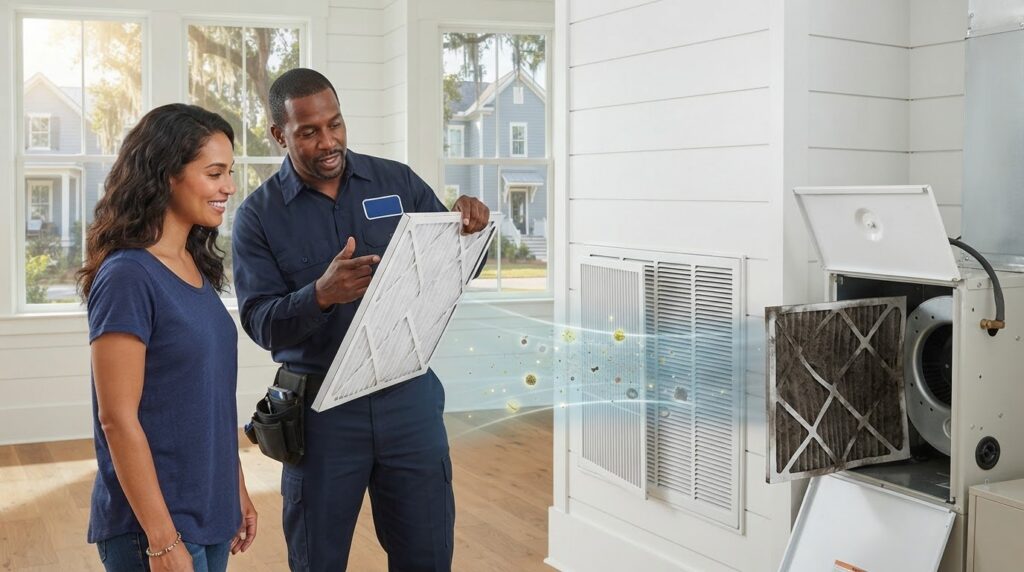
The thickest, highest-rated air filter on the store shelf might actually be the worst purchase you can make for your home. When you’re dealing with persistent indoor dust, pollen, or heavy coastal humidity, it’s natural to assume that maximum filtration always wins. But what is MERV, and why do experienced technicians warn that the wrong rating can quietly suffocate your system?
Standing in the aisle surrounded by competing scales like MERV, MPR, and FPR is genuinely confusing. You want fresh, healthy air, but you don’t want an overworked blower motor or spiking electric bills caused by restricted airflow. In this guide, you’ll learn how the MERV scale measures particle capture, how static pressure impacts equipment life, and how to choose the ideal balance for your home.
We’ll walk through the rating chart step by step, decode manufacturer ratings, and share a simple maintenance routine to keep your air clean and your system running smoothly.
Key Takeaways
- Understanding what is MERV gives you the exact baseline for how well a filter captures airborne particles between 0.3 and 10 microns.
- While testing scales reach up to MERV 20, most residential HVAC equipment is engineered to operate safely and effectively between MERV 6 and MERV 13.
- Higher filtration ratings aren’t automatically better, since overly dense weaves create airflow resistance that strains blower motors and elevates power bills.
- Matching your filter’s thickness and rating to your family’s respiratory sensitivities and local climate protects indoor air without restricting system ventilation.
- Checking your filter visually every 30 days protects your equipment from unexpected dust buildup and premature mechanical wear.
What Is MERV? The Standardized HVAC Filter Rating Explained
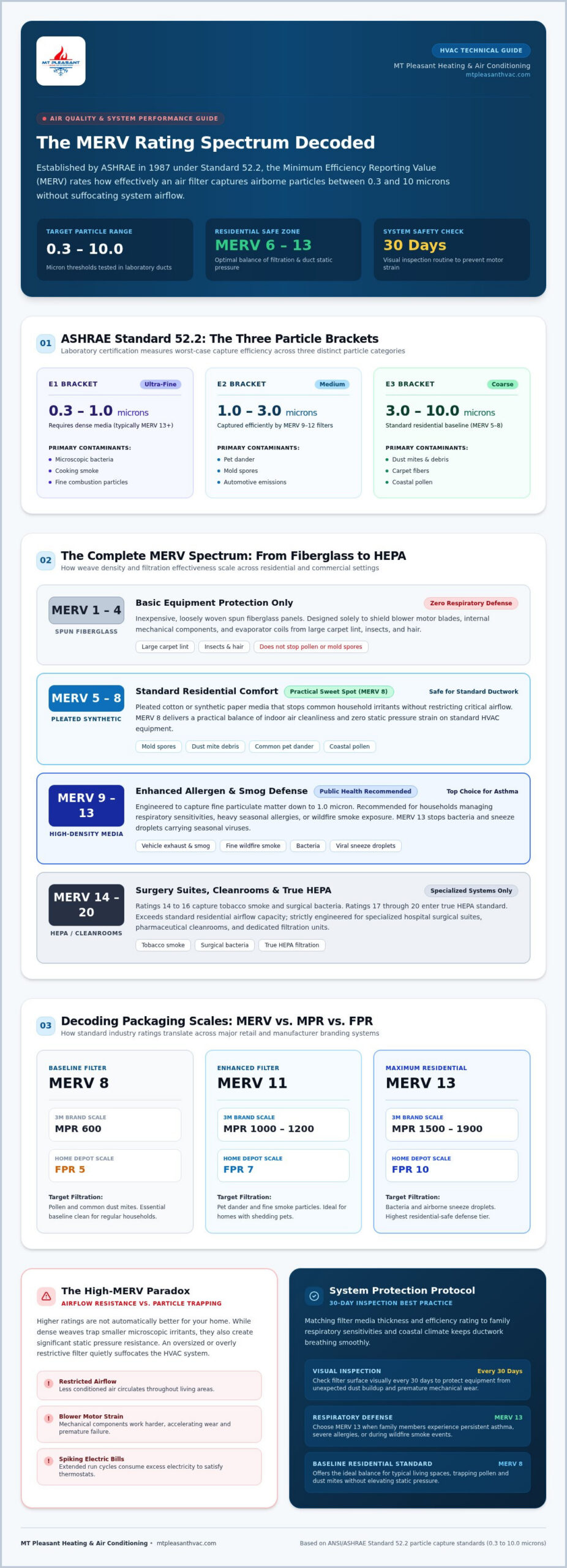
If you have ever stared at the filter aisle wondering what is MERV, you are looking at the universal yardstick for indoor air filtration. The Minimum Efficiency Reporting Value (MERV) was created by the American Society of Heating, Refrigerating and Air-Conditioning Engineers (ASHRAE) in 1987. The rating measures how effectively an air filter captures airborne particles between 0.3 and 10 microns as air cycles through your ductwork. Higher numbers mean a denser weave that traps microscopic irritants, but that extra density also changes how freely air circulates through your equipment.
Your filter serves a dual purpose. It protects your family’s lungs from allergens, and it protects delicate blower motors and evaporator coils from suffocating layers of grime.
The Origins and Testing Behind ASHRAE Standard 52.2
ANSI/ASHRAE Standard 52.2 stands as the industry-accepted benchmark for testing general ventilation air-cleaning devices by particle size. During laboratory certification, technicians inject controlled synthetic dust and aerosol particles across a test duct to evaluate the filter. Rather than grading filters on average performance, this protocol records the minimum efficiency, or worst-case capture rate, across three specific particle brackets:
- E1 (0.3 to 1.0 microns): Microscopic bacteria, cooking smoke, and fine combustion particles.
- E2 (1.0 to 3.0 microns): Pet dander, mold spores, and auto emissions.
- E3 (3.0 to 10.0 microns): Dust mites, carpet fibers, and coastal pollen.
MERV vs. MPR vs. FPR: Decoding the Packaging Confusion
Retail filter aisles often hide MERV ratings behind proprietary marketing systems. Brands like 3M developed Microparticle Performance Rating (MPR) to highlight microscopic particle capture, while The Home Depot introduced Filter Performance Rating (FPR) using a 1-to-10 color code. These brand-specific scales make side-by-side shopping confusing, but you can decode them using standard MERV equivalents:
- MERV 8: Aligns roughly with MPR 600 and FPR 5 (traps pollen and dust mites).
- MERV 11: Matches MPR 1000 to 1200 and FPR 7 (captures pet dander and smoke particles).
- MERV 13: Corresponds to MPR 1500 to 1900 and FPR 10 (stops bacteria and sneeze droplets).
Learning what is MERV beneath these commercial labels keeps you from buying overpriced filters that don’t match your system’s operational needs.
The Complete MERV Scale: From Basic Dust Catchers to Hospital Cleanrooms
The full scale spans from MERV 1 up to MERV 20, covering everything from porous fiberglass screens to sterile pharmaceutical cleanrooms. Most residential heating and cooling systems operate safely and efficiently between MERV 6 and MERV 13. Understanding what is MERV across this spectrum helps you see where household filtration ends and specialized air scrubbing begins. As detailed in the EPA’s overview on What Is a MERV Rating?, each tier targets specific particulate thresholds based on weave density.
MERV 1 to 4: Basic Equipment Protection Only
Spun fiberglass styles represent the bottom tier. These inexpensive, loosely woven panels only stop large carpet lint, insects, and hair from collecting on internal mechanical parts. They offer virtually zero respiratory protection against pollen, mold spores, or dust mites. Think of them strictly as protective shields for your blower motor blades, not as wellness tools for your family’s lungs.
MERV 5 to 8: Standard Residential Comfort
Constructed with pleated cotton or synthetic paper media, these filters capture mold spores, dust mite debris, and common pet dander. For many homes, MERV 8 provides a practical sweet spot. It delivers noticeable baseline cleanliness throughout the living spaces without placing unnecessary static pressure on standard ductwork or restricting critical airflow.
MERV 9 to 13: Enhanced Allergen and Smog Defense
Stepping into this range captures fine particulate matter down to 1 micron, including vehicle exhaust, smog, and fine wildfire smoke. MERV 13 filters even capture bacteria and droplet nuclei carrying common seasonal viruses. Public health agencies frequently recommend MERV 13 for superior indoor air defense, making it an excellent choice for households managing persistent asthma or respiratory sensitivities.
MERV 14 to 20: Cleanrooms, Surgery Suites, and HEPA
Ratings from 14 to 16 catch tobacco smoke and surgical bacteria, while MERV 17 through 20 enter true HEPA territory to stop particles smaller than 0.3 microns. These ultra-dense media require the powerful industrial fans found in semiconductor cleanrooms and hospital operating rooms. Standard residential blowers simply cannot push air through this density. Forcing a home system to pull through a HEPA-grade filter causes severe coil freezing and motor failure. When balancing filtration and blower limits, scheduling routine HVAC maintenance is the best way to verify your equipment’s airflow capacity before making a drastic change.
The High-MERV Paradox: When Better Filtration Damages Your HVAC System
Buying the highest number available feels like an easy victory for clean air, but dense filter weaves naturally resist airflow. Your heating and cooling equipment functions much like a set of mechanical lungs. When a filter blocks circulation, the system must fight against intense resistance just to pull return air through the ductwork. If you don’t evaluate what is MERV in relation to your system’s design, you risk creating excessive static pressure that accelerates mechanical wear and strains critical components.
Without sufficient airflow passing across the indoor evaporator coil, the refrigerant inside cannot absorb ambient heat from your living areas. As coil temperatures plummet below freezing, moisture in the air condenses and rapidly forms solid blocks of ice along the metal fins. Choked airflow forces your compressor to run endlessly, turning a modern high-efficiency air conditioner into an inefficient, power-hungry energy hog.
Understanding Static Pressure and Blower Motor Strain
Static pressure measures the internal resistance against air circulating throughout your duct network. Older systems equipped with permanent split capacitor (PSC) motors cannot adapt to high pressure; they simply slow down, reducing room comfort while the motor windings overheat. Modern variable-speed ECM blower motors attempt to overcome this restriction by ramping up rotational speed. While this maintains airflow, running continuously at peak output generates extreme heat, trips high-limit safety switches, and can burn out expensive motor modules prematurely.
The 1-Inch Filter Trap: Thickness vs. Surface Area
Most residential return grilles accommodate standard 1-inch filter tracks. Squeezing a dense MERV 11 or MERV 13 rating into a 1-inch frame forces air through a tight, shallow space that clogs quickly. In contrast, 4-inch or 5-inch whole-house media cabinets use deep, accordion-like pleats that provide significantly more media surface area:
- Greater dust-holding capacity: Particulates distribute across multiple square feet of fabric rather than a flat surface.
- Lower initial pressure drop: Air glides easily through the expanded surface without taxing the blower fan.
- Extended service intervals: Thicker media lasts months longer before reaching restrictive dirt thresholds.
If your family needs hospital-grade air purification, retrofitting a deep-media cabinet into your return duct creates an effective solution. Exploring what is MERV without considering filter thickness often leads directly to avoidable service disruptions.
How to Choose the Right MERV Rating for Your Home
Selecting the ideal filter comes down to balancing your family’s personal health needs with the operational limits of your cooling and heating equipment. Rather than grabbing the highest number on the shelf, take a look at your equipment manual to check the maximum rated static pressure drop. Understanding what is MERV in practical terms means finding that sweet spot where you eliminate irritants without choking off airflow.
Every home has a unique breathing profile. To narrow down your choice, evaluate these key household factors:
- Occupant sensitivities: Severe allergies or asthma require finer filtration.
- Pet count: Multiple cats or shedding dogs load filters quickly with hair and micro-dander.
- Local environment: Heavy spring pollen or regional humidity alters how fast media pores clog.
Matching MERV Ratings to Your Household Needs
For a single occupant or a couple without pets or chronic allergies, MERV 8 offers plenty of protection. It captures basic household dust, keeps the evaporator coil clean, and preserves wide-open airflow. If your family includes multiple pets or family members with seasonal allergies, stepping up to MERV 11 captures finer pet dander and outdoor spores without creating excessive drag on most modern blowers.
Reserve MERV 13 for households with heightened respiratory concerns, such as immune-compromised individuals, or for properties exposed to heavy smoke or severe pollen seasons. Just be sure your duct system and air handler can handle the extra resistance before making this change permanent.
Special Considerations for Coastal and Humid Climates
Living along the coast changes the rules of air filtration. Lowcountry humidity brings heavy moisture loads, which can cause organic dust caught in a filter to turn damp. A damp, dust-caked filter provides an ideal breeding surface for mold spores and mildew right at the entrance of your supply ductwork. Overly dense filters also slow down air velocity, reducing your system’s ability to pull moisture out of the air during hot summer afternoons.
If you aren’t sure how much airflow your duct network can safely handle, scheduling a comprehensive seasonal HVAC inspection allows a technician to measure static pressure directly. When you want complete peace of mind about your system’s performance, schedule professional HVAC maintenance to ensure your setup breathes freely through every humid season.
Filter Maintenance Best Practices to Protect Your Air and Equipment
Manufacturer packaging often boldly claims a filter lasts a full ninety days, but treating that timeline as a universal rule causes trouble. A filter should be visually inspected every 30 days. While understanding what is MERV helps you pick the right baseline efficiency, disciplined upkeep is what actually keeps your equipment healthy. When sliding a fresh filter into the cabinet, always confirm the directional airflow arrows point toward the blower motor. Inserting a filter backward weakens the structural cardboard frame, which can cause the media to collapse directly into the fan housing under heavy suction.
Establishing an Inspection and Replacement Schedule
Standard 1-inch residential filters typically need replacement every 30 to 90 days, though several everyday household conditions can cut that lifespan in half:
- Heavy pet shedding: Fur and fine dander mat across the filter surface, sealing off airflow within weeks.
- Peak summer operation: Extended cooling run times circulate thousands more cubic feet of air each day.
- Home remodeling: Drywall dust and floor sanding debris will instantly clog fresh filter pleats.
A simple visual check tells the true story: remove the filter and hold it toward a bright lamp or window. If light cannot easily shine through the media, dirt is choking the pleats and it is time for a fresh one. While homeowners can easily manage this monthly check, larger business facilities face heavier foot traffic and higher ventilation demands, requiring tailored commercial HVAC maintenance programs to maintain steady airflow balance.
Warning Signs Your Filter Is Choking Your System
Your HVAC system usually gives audible and physical clues when an air filter is overloaded. You might notice a sharp whistling sound at the return grille as the blower strains to pull air through clogged fibers. Other common symptoms include weak airflow at distant supply vents, hot and cold spots across different rooms, and your air conditioner blowing lukewarm air during the hottest part of the day.
When you ask what is MERV rating limits for your specific unit, remember that a neglected, dust-packed filter turns even a low-rated media into an impenetrable wall. If you insert a fresh filter and your system still struggles to circulate air or short-cycles constantly, an underlying mechanical issue could be developing. Reaching out for prompt, reliable AC repair ensures any motor strain or refrigerant line issues are diagnosed before small problems cause permanent equipment failure.
Protect Your Airflow and Breathe Easier at Home
Gaining clarity on what is MERV shifts your focus from chasing maximum numbers to finding genuine mechanical balance. A filter’s real job is capturing airborne irritants without placing excessive static pressure on your blower fan or freezing your cooling coils. Inspecting your media every 30 days and pairing your household needs with the right rating keeps your indoor air clean and your utility bills in check.
When unexpected airflow drops or system shutdowns happen, having a dependable neighbor in your corner makes all the difference. Our experienced diagnostic technicians focus on fixing what is broken and preserving your equipment rather than pushing costly, unneeded replacements. Backed by fast 24/7 local emergency repair response across the Lowcountry, we are always ready to help. Keep your home comfortable and your equipment running strong with our local HVAC team.
Frequently Asked Questions
Can a high MERV rating damage my residential HVAC system?
Yes, installing a filter with a rating higher than your equipment’s design capacity can cause serious mechanical damage. When you evaluate what is MERV limits for your equipment, you avoid excessive static pressure. Overly dense media suffocates airflow, causing evaporator coils to freeze into solid ice and forcing the blower motor to overheat. In severe cases, this restriction leads to premature motor burnout and complete compressor failure.
What is the difference between MERV 8 and MERV 11?
The primary difference lies in the density of the weave and the size of particles captured. A MERV 8 filter traps larger airborne irritants like pollen, dust mites, and carpet fibers while allowing unrestricted airflow. MERV 11 media uses tighter pleats to capture microscopic pet dander, auto emissions, and fine smoke. For most Mount Pleasant homes with shedding dogs or mild allergies, MERV 11 provides noticeably cleaner air without overloading standard duct systems.
Is a MERV 13 filter worth it for everyday home use?
A MERV 13 filter is worth the investment only if household members suffer from severe respiratory issues and your ductwork supports it. MERV 13 traps bacteria, virus carriers, and fine smoke particles. However, standard 1-inch return vents struggle with the airflow resistance it creates. In coastal climates like Charleston, dense filters clog quickly with humid dust, so you need a deeper 4-inch media cabinet or a verified high-capacity blower before making the switch.
How often should I change a high-MERV pleated air filter?
You should visually check high-MERV pleated filters every 30 days and replace 1-inch varieties every 30 to 60 days. Higher-efficiency filters capture significantly more debris, meaning their pores load much faster than basic fiberglass screens. In homes with multiple pets, active renovations, or during muggy Lowcountry summers when air conditioning runs around the clock, you may need to swap your filter monthly to keep static pressure within safe operational boundaries.
What happens if I install an air filter backward?
Installing an air filter backward severely restricts airflow and risks collapsing the filter directly into your air handler. Air filters are built with directional wire or cardboard reinforcement on the downstream side to withstand suction. When installed in reverse, air pushes against the unsupported face, causing the media to bend, buckle, or tear. Unfiltered dust then bypasses the edges completely, coating your sensitive evaporator coils and blower wheel in abrasive grime.
Why don’t residential HVAC systems use true HEPA filters?
Residential heating and cooling systems lack the extreme fan power required to push air through true HEPA media. True HEPA ratings start around MERV 17, using microscopic glass fibers that create intense air resistance. Standard residential blowers designed for MERV 8 through 13 cannot generate enough pressure to circulate air through such a tight barrier. Forcing a residential system to breathe through HEPA media quickly burns out motors and triggers emergency shutdowns.
Does a higher MERV rating increase my home electric bill?
Yes, a higher MERV rating can raise your electric bill if your HVAC system must fight excessive resistance. When researching what is MERV efficiency, homeowners often overlook fan energy. Denser filter media causes your blower motor to draw more amperage or run longer cycles to satisfy the thermostat. That restricted circulation forces your air conditioner to labor extended hours during hot Charleston afternoons, directly inflating your monthly cooling expenses.