


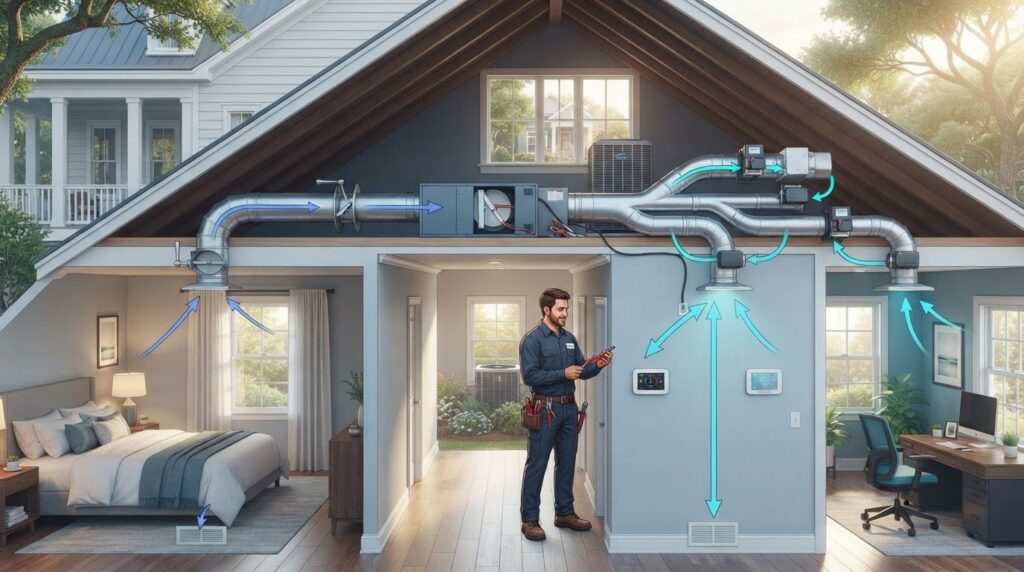
Could a room that’s always too warm need a whole-home zoning system, or would an airflow adjustment help? An ac damper regulates how much air moves through part of your ductwork. HVAC zoning coordinates multiple dampers and controls to manage temperatures in separate areas. They’re related, but they aren’t the same thing.
If your bedroom runs hot while the living room feels chilly, it’s reasonable to wonder whether a damper is the answer. Uneven temperatures can have several causes, so adding equipment isn’t automatically the right fix. Start by understanding how your ductwork and existing controls distribute air.
This guide explains what an AC damper controls, how it fits into a zoning system, and what to consider before changing your home’s airflow. You’ll find practical questions to ask about manual and motorized dampers, thermostats, and duct layouts. If the problem persists or controls behave unexpectedly, a professional HVAC evaluation can help clarify the issue before you decide what needs to change.
Key Takeaways
- Trace how air moves from your HVAC equipment through the ducts to each room to better understand where an airflow concern may begin.
- An ac damper adjusts airflow along a duct path, while zoning coordinates controls across separate areas of the home.
- Note which rooms feel uncomfortable and when. Then check thermostat settings and accessible supply registers without opening HVAC equipment.
- Before considering changes, ask how your ductwork and existing controls work together and which options address the specific symptoms.
- If comfort problems persist or controls act unexpectedly, an HVAC evaluation can help clarify the issue before you commit to added equipment.
AC damper vs. HVAC zoning: understand the difference before choosing
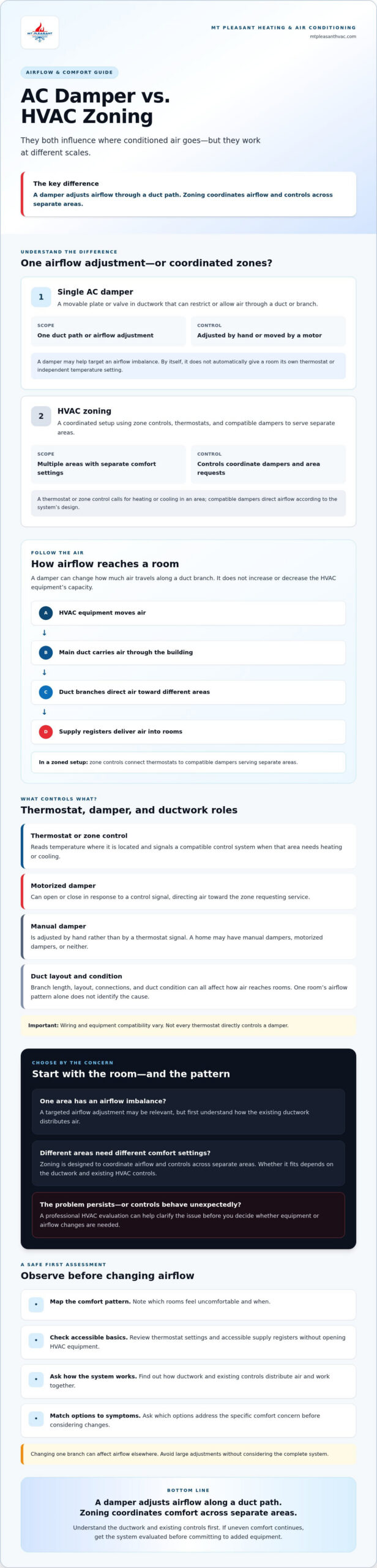
Does one bedroom stay warm while the rest of the house feels comfortable? Or does an upstairs room never seem to match the thermostat setting? Uneven temperatures often prompt homeowners to ask whether they need a damper or a zoning system. They address airflow at different scales: a damper adjusts air through a duct path, while zoning coordinates airflow and controls across separate areas.
An ac damper is a movable plate or valve inside ductwork that can restrict or allow air through a branch. For a technical overview of what an AC damper is, see how dampers regulate flow in duct systems. A single damper may help adjust the air reaching an area, but it doesn’t automatically give that room its own thermostat or independent temperature setting.
| Feature | Single damper | HVAC zoning |
|---|---|---|
| Function | Adjusts airflow through a duct or branch | Coordinates airflow to serve separate areas |
| Controls | May be adjusted manually or controlled by a motor | Uses zone controls, thermostats, and compatible dampers |
| Scope | One duct path or airflow adjustment | Multiple areas with separate comfort settings |
| Typical use | Targeting an airflow imbalance | Managing comfort needs that differ across areas |
What does an AC damper control?
A damper changes how much air can move through a duct or branch. Some are set by hand and left in position; others use a motor to move in response to a control signal. A home may have one type, the other, or no accessible dampers for homeowners to adjust. Changing one damper alone doesn’t necessarily create independently controlled zones.
What makes HVAC zoning a system?
Zoning combines several components. A thermostat or zone control calls for heating or cooling in an area, and compatible dampers direct airflow according to the system’s design. Each zone can have its own comfort setting, though controls and equipment vary by installation. For a foundational explanation of dampers and airflow, read the HVAC damper and airflow guide.
The right setup depends on your existing ductwork and HVAC controls, not just on which room feels uncomfortable. A targeted airflow adjustment and coordinated zoning differ in scope. Before choosing, ask how your current system distributes air and whether its controls can support the proposed change.
How AC dampers, thermostats, and ductwork work together
To understand why one room gets less conditioned air than another, follow the airflow path: HVAC equipment moves air into the ductwork, ducts carry it through the building, and supply registers deliver it into rooms. Duct branches direct air toward different areas. A damper in a branch can change how much air travels that way, but it doesn’t increase or decrease the equipment’s capacity.
Simple airflow diagram: HVAC equipment → main duct → duct branches with dampers → supply registers in rooms. In a zoned setup, zone controls connect thermostats to compatible dampers serving separate areas.
How a motorized damper responds to a thermostat
A thermostat reads the temperature where it’s located and sends a signal to a compatible control system when that area needs heating or cooling. In a zoned system, the control may signal a motorized damper to open or close, directing air to the zone requesting service. The thermostat measures temperature; the damper changes position. Wiring and equipment compatibility vary, so not every thermostat directly controls a damper.
Manual dampers work differently: someone adjusts them by hand rather than using a thermostat signal. A system may have manual dampers, motorized dampers, or neither. Closing or partly closing a branch can redirect airflow, but it doesn’t make the HVAC equipment produce more heating or cooling.
Why duct design matters to airflow balance
Airflow depends on more than the position of one damper. The length and layout of duct branches, their connections, and the condition of the ductwork can all affect how air reaches rooms. For example, a room at the end of a long branch may receive a different airflow pattern than one close to the main duct. That observation alone doesn’t identify the cause or prove that adding or adjusting a damper is the answer.
Because changing one branch can affect airflow elsewhere, avoid making large adjustments without considering the complete system. If room comfort remains uneven or controls behave unexpectedly, an HVAC evaluation can help clarify how the ductwork and controls interact. For more background on zone comfort, see the AC zoning comfort guide.
For homeowners in Mount Pleasant and Charleston, a careful diagnosis can help distinguish a control issue from a broader airflow concern. To learn more about help with thermostat behavior, visit thermostat service from MT Pleasant Heating & Air Conditioning.
When a single AC damper may help, and when zoning is a better fit
A room with noticeably weaker airflow than nearby rooms may need a closer look at how air is distributed. A damper could be one place to check, but the symptom doesn’t confirm that the damper is the cause. A focused airflow adjustment affects one duct path; zoning coordinates comfort controls across separate areas.
When targeted airflow adjustment may be considered
If one area consistently seems to receive less air, an HVAC professional can check whether a damper is present, identify its type, and assess whether its position suits the system. The evaluation should consider the duct layout and other airflow conditions, not just the room that feels uncomfortable. Don’t force a stuck damper or make unverified changes. Shifting airflow in one branch can affect other parts of the home.
When zoning may be worth evaluating
Zoning may be worth evaluating when comfort needs differ by floor, a home addition has different heating or cooling needs, or some rooms are used on a different schedule from the rest of the house. Separate settings can give those areas more independent control, but zoning isn’t compatible with every system. Feasibility depends on the HVAC equipment, ductwork, and control setup. If thermostat behavior is part of the concern, see this thermostat repair and service guide.
Persistent uneven comfort can have causes beyond damper settings. Before choosing a solution, describe when and where the problem occurs and use these questions to guide a conversation with an HVAC professional:
| Homeowner goal or concern | Question to ask |
|---|---|
| One room gets noticeably less airflow | Is there a damper on this branch, and are its type and position appropriate? |
| Upstairs and downstairs feel different | Could the existing system support separate control for these areas? |
| A room or addition has distinct comfort needs | How would the duct layout and equipment affect zoning options? |
| Thermostat settings don’t match how the home feels | Are the thermostat, controls, and dampers communicating as intended? |
| The proposed fix involves new equipment | What did the evaluation find, and is a simpler adjustment appropriate? |
Match the scope of the solution to the problem. A single ac damper adjustment may address a particular airflow path. Zoning is broader and requires compatible controls and system design. Ask what the evaluation found before deciding which option, if any, is appropriate.
How to assess an AC damper or zoning concern safely
You can gather useful clues without opening HVAC equipment or adjusting concealed components. A brief, consistent record of what you notice can help an HVAC professional assess whether the concern may involve airflow, controls, or another part of the system.
What homeowners can observe safely
For a few days, note which rooms feel too warm or cool and when you notice the difference. Compare rooms under similar conditions, such as at the same time of day, and record the thermostat setting and displayed temperature. Check that accessible supply registers aren’t blocked by furniture, rugs, or curtains.
- Write down where airflow feels weak or different from usual.
- Note unusual sounds, such as rattling or a new humming noise, and when they occur.
- Record whether the issue began after recent HVAC work or a change in how the system is used.
Keep the thermostat at a setting that suits your household, and observe the system rather than repeatedly changing the setting to test it. Don’t remove access panels, reach into ductwork, or try to move a stuck damper. A powered or concealed ac damper may connect to controls or wiring that should be assessed by a qualified professional.
What to share during an HVAC evaluation
Bring your notes and describe the affected rooms, when the discomfort occurs, thermostat readings, unusual sounds, and any recent system changes. Ask what the evaluation will cover. For example, will it include the dampers and controls, the ductwork, and how the HVAC equipment is operating?
If a larger system change is recommended, ask what the findings showed and how each option addresses the problem. You can also ask whether a repair or adjustment is appropriate before agreeing to broader changes. Clear explanations make it easier to understand the recommendation and choose a next step.
If the problem persists or the controls behave unexpectedly, an HVAC evaluation can help clarify what’s happening without assuming new equipment is needed. Ask the local HVAC team about an evaluation.
Choosing a next step for AC dampers in Mount Pleasant
A single damper adjustment and a zoning system address problems at different scales. An adjustment affects airflow along a duct path; zoning coordinates controls across separate areas of a home. In either case, the right next step depends on what’s causing the comfort issue and how your ductwork, thermostat, and HVAC equipment work together.
Homes in Mount Pleasant and the broader Charleston area have varied layouts and comfort needs, so there isn’t one universal fix. Persistent temperature differences or controls that don’t respond as expected are reasons to seek an evaluation, not proof that a part needs replacement or that zoning is necessary. Describe the symptoms and ask what the inspection found.
Questions to ask before approving a change
Before agreeing to work on an ac damper or considering a broader control change, ask the HVAC professional to explain the recommendation in plain language. Useful questions include:
- What inspection findings support this repair, adjustment, or system change?
- How will the proposed work interact with my current thermostat, controls, and ductwork?
- Could a repair or adjustment address the concern before replacing a component or adding equipment?
- What other possible causes of the uneven comfort were considered?
These questions help you judge whether the proposed solution matches the problem. A clear diagnosis should connect the symptoms with the recommended work. If the recommendation involves a larger change, ask why a simpler option would not address the issue.
When to request professional HVAC help
Consider requesting an evaluation if room-to-room comfort differences continue, a thermostat or control doesn’t respond as expected, or airflow changes occur alongside unusual equipment operation or repeated shutdowns. Don’t try to access concealed or powered parts yourself. When contacting a local Mount Pleasant HVAC provider, describe which rooms are affected, when the problem happens, what the thermostat displays, and whether anything changed before the symptoms began.
MT Pleasant Heating & Air Conditioning serves Mount Pleasant and the greater Charleston area with HVAC repair and maintenance. A professional assessment can help clarify what’s happening and identify appropriate next steps without assuming a damper replacement or zoning system is required.
Ready to discuss persistent comfort concerns with a local team? Contact the Mount Pleasant HVAC team.
Choose the next step that fits your comfort concern
A single ac damper adjusts airflow through a duct path, while HVAC zoning coordinates controls and dampers to manage separate areas. Neither option is automatically better. The right approach depends on your home’s ductwork, equipment, and controls, as well as the cause of the uneven comfort.
Before approving a repair or larger system change, ask what the evaluation found and how the recommendation fits your existing setup. Persistent temperature differences, unusual equipment behavior, or controls that don’t respond as expected are good reasons to seek professional guidance. Clear diagnostics can help identify an appropriate next step without assuming you need new equipment.
MT Pleasant Heating & Air Conditioning is locally owned and operated in the Lowcountry, offering HVAC repair, installation, and maintenance for residential and commercial customers. If you’d like help understanding a comfort issue, contact the Mount Pleasant HVAC team to discuss your concerns.
Frequently Asked Questions
Is an AC damper the same as an HVAC zoning system?
No. An AC damper is a ductwork component that adjusts airflow through a duct or branch. An HVAC zoning system coordinates compatible dampers with controls, often including thermostats, to manage comfort settings in separate areas. One damper alone doesn’t necessarily give a room independent temperature control. The right setup depends on the home’s ductwork, HVAC equipment, and existing controls.
Can you add a damper to existing HVAC ductwork?
Possibly, but suitability depends on the duct layout, access, and how the proposed damper would affect the rest of the system. A professional should assess those details before planning the work. Ask what problem the damper is intended to address and whether an adjustment or repair to existing components could help. Don’t cut into ductwork or install a damper yourself.
How does an AC damper work with a thermostat?
A thermostat measures the temperature where it’s located and signals a compatible control system when heating or cooling is needed. In some zoned systems, that control can signal a motorized damper to open or close, directing airflow to an area. The thermostat senses temperature; the damper changes position. Not every system connects them this way, and controls and wiring vary by installation.
What happens if an HVAC damper is stuck?
A stuck damper may remain open, closed, or partly restricted, changing airflow to the rooms served by that duct branch. You might notice weaker airflow or a room that feels different from usual, but those symptoms can have other causes too. Don’t force a concealed or powered damper. If comfort problems persist or controls behave unexpectedly, arrange an HVAC evaluation in Mount Pleasant or Charleston.
Do I need zoning to fix uneven room temperatures?
Not necessarily. Uneven comfort can relate to airflow through a particular duct, thermostat behavior, duct layout, or other system conditions. Zoning may be worth evaluating if separate areas have distinct comfort needs, but feasibility depends on the equipment, ductwork, and compatible controls. Start by noting which rooms are affected and when. A professional evaluation can help determine whether a targeted adjustment, repair, or broader solution fits.
Can closing AC dampers reduce energy use?
Not reliably. Closing dampers changes how air is distributed, but it doesn’t make the HVAC equipment produce less heating or cooling. Restricting airflow without understanding the system’s design may interfere with its intended balance and leave other rooms less comfortable. Avoid closing multiple dampers as an energy-saving strategy unless a qualified HVAC professional recommends it after evaluating your setup. A measured assessment is a better starting point.
Related guides: how AC zoning works, multi-zone HVAC systems and what an HVAC damper does. For professional help, see AC installation.
Need a hand with this? Mount Pleasant Heating & Air Conditioning has served Lowcountry homes and businesses since 2007, with 24/7 emergency service.
Call (843) 714-0863 or request service online. Related service: AC installation and replacement.