


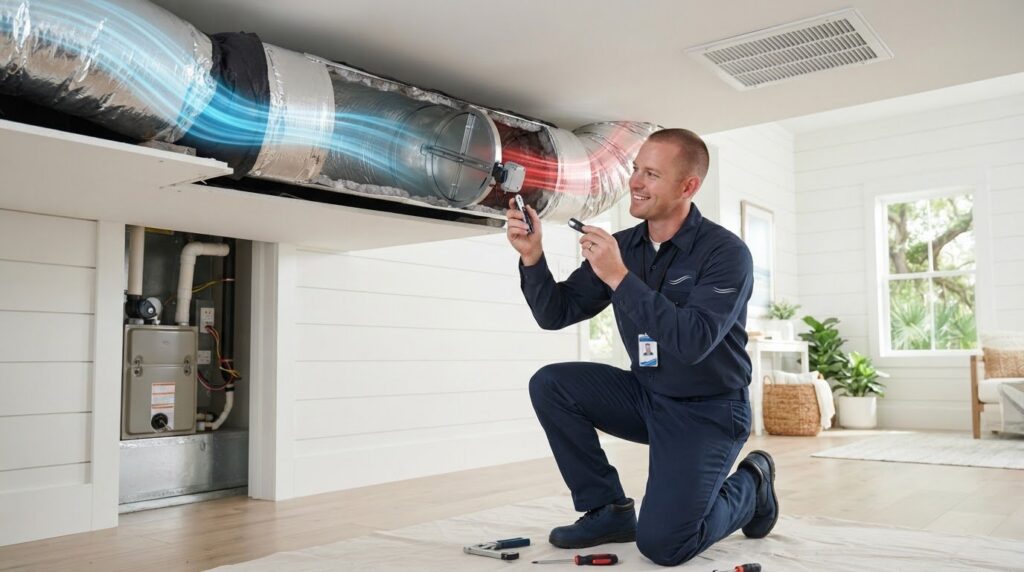
What if the room that never seems comfortable isn’t a thermostat problem? Uneven temperatures and weak airflow can leave you wondering what’s happening behind the vents. If you’ve asked, “what is a damper,” it’s a movable part inside your ductwork that helps control where heated or cooled air goes. A damper could be involved, but other HVAC issues can cause similar symptoms.
You don’t need to know every technical detail to understand your system. This guide explains how dampers affect airflow, compares common types, and covers signs that may point to a problem. You’ll also learn which basic checks are reasonable for a homeowner and what not to adjust. If the cause remains unclear, an HVAC professional can inspect the system.
Key Takeaways
- Wondering “what is a damper”? It’s a movable part in your ductwork that helps regulate where conditioned air flows.
- Manual, motorized, balancing, zone, and backdraft dampers serve different purposes. Your system may use only some of them.
- A stuck or misadjusted damper may contribute to uneven temperatures, but it’s not the only possible cause.
- Start with simple checks: confirm the thermostat setting, inspect the filter, and make sure registers aren’t blocked.
- If airflow remains uneven, a local HVAC technician can assess accessible duct components, controls, and other possible causes.
What Is a Damper in an HVAC System, and How Does It Control Airflow?
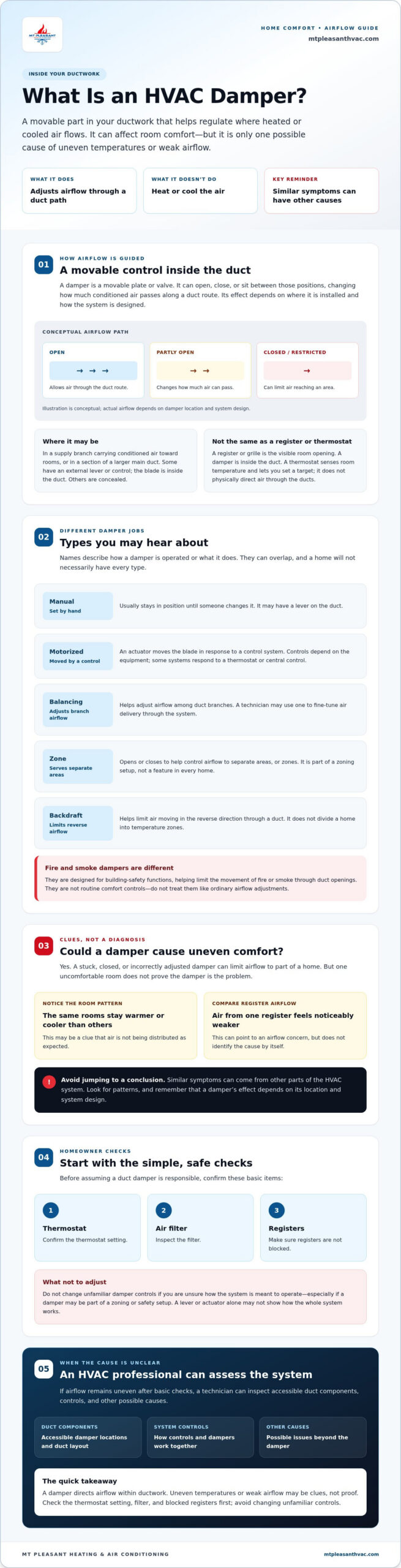
If you’re asking what is a damper, here’s the simple answer: it’s a movable plate or valve inside an HVAC duct that regulates how much conditioned air can pass through. A damper can open, close, or sit between those positions, changing airflow along a duct. It doesn’t heat or cool the air. Your HVAC equipment does that, while the damper helps direct the air to different parts of the home. For a general overview of how dampers regulate airflow, see Damper (flow).
Think of ductwork as a network of pathways. A damper in one section can restrict or allow airflow along that route, affecting how much air reaches a room or area. Its effect depends on where it’s installed and how the system is designed. Unlike a switch for the whole HVAC system, a damper adjusts airflow within the duct network.
Where Is a Damper Located in an HVAC System?
Dampers are commonly installed in supply branches, which carry conditioned air toward rooms, or in sections of a larger main duct. Some have an external lever or control, but the blade sits inside the duct. Others are concealed, so you may not see them from a room or at the register. Location and access vary by system, and a technician may need to inspect the duct layout to identify a damper.
How Is a Damper Different From a Vent or Thermostat?
A supply register or grille is the visible opening where air enters a room. A duct damper sits inside the duct and controls airflow before it reaches that opening. The terms can be confused because both can affect how much air you feel, but they’re different components in different locations.
A thermostat senses room temperature and lets you set a target. It doesn’t physically direct air through the ducts. If the thermostat isn’t responding as expected, the issue may be separate from a damper. Learn more about thermostat repair in Mount Pleasant. Knowing what each component does can help you describe a comfort concern without guessing at the cause.
Which HVAC Damper Types Control Different Kinds of Airflow?
Dampers can be operated by hand, moved by a control system, or designed for a specific airflow task. The labels may overlap: a zone damper is typically motorized, while a balancing damper describes its role in adjusting airflow. Names and setups vary, so a home won’t necessarily have every type.
What Is the Difference Between Manual and Motorized Dampers?
A manual damper is set by hand and usually stays in position until someone changes it; a motorized damper moves in response to a control system. A manual model may have a lever on the duct, while a motorized one uses an actuator to move its blade. The controls depend on the equipment. In some systems, the motor responds to a thermostat or central control; other setups may operate differently.
What Do Balancing, Zone, and Backdraft Dampers Do?
These names describe different jobs, not interchangeable parts:
- Balancing dampers help adjust airflow among duct branches. A technician may use them to fine-tune air delivery through the system.
- Zone dampers open or close to help control airflow to separate areas, or zones. They’re part of a zoning setup, not a feature in every home.
- Backdraft dampers help limit air moving in the reverse direction through a duct. They don’t divide a home into temperature zones.
Fire and smoke dampers have a different purpose. They’re designed for building-safety functions, helping limit the movement of fire or smoke through duct openings. They aren’t routine comfort controls, and homeowners shouldn’t treat them like ordinary airflow adjustments.
Knowing the type can help you describe what you see, but a lever or actuator alone may not show how the whole system is meant to operate. Avoid changing unfamiliar controls, especially if you’re unsure whether a damper is part of a zoning or safety setup. If you’re weighing whether a single AC damper or a full HVAC zoning system is the right solution for your home, understanding how these components differ can help you ask better questions. If airflow concerns persist, a local HVAC professional can assess the system and its controls. For homeowners in Mount Pleasant and the greater Charleston area, local HVAC repair and diagnostics can be a practical next step when the cause isn’t clear.
Can a Damper Cause Uneven Temperatures or Weak Airflow?
Yes. A damper that’s stuck, closed, or incorrectly adjusted can limit airflow to part of a home. But one uncomfortable room doesn’t prove the damper is the problem. Similar symptoms can come from other parts of the HVAC system, so look for patterns rather than jumping to a diagnosis.
What Signs Might Point to a Damper or Airflow Issue?
Notice whether the same rooms stay warmer or cooler than others, or whether air from one register feels noticeably weaker than airflow elsewhere. These can be clues that air isn’t being distributed as expected, but they don’t identify the cause on their own.
Pay attention to where and when the problem occurs. Does it affect one room, several rooms on the same level, or much of the house? Does it persist during heating or cooling, or come and go? Note which rooms feel uncomfortable and when. That pattern can help a technician investigate.
Why Can a Damper Symptom Have Another Cause?
Airflow can be restricted in several ways. A dirty filter can limit air moving through the system, while furniture or other objects blocking a register can interfere with delivery into a room. Duct restrictions or damage, equipment performance, and system controls may also contribute to uneven comfort. If you’re trying to figure out what is a damper doing in this situation, remember that it’s one part of a larger airflow system, not the only possible explanation.
Consider how widespread the symptoms are. Weak airflow at one register may point to a local issue, while poor cooling across several rooms could involve broader system performance. Neither pattern confirms a specific fault, but describing what you notice helps narrow down what needs checking. If cooling problems persist across the home, AC repair in Mount Pleasant may be relevant.
A damper can affect how air travels, but similar room-to-room symptoms can have different causes. A professional assessment can help identify the source rather than relying on one clue alone.
What Can You Safely Check Before Calling an HVAC Professional?
A few simple observations can help rule out common issues and explain what’s happening. You don’t need to open ductwork or reach for tools. Start with controls and parts you can access safely, then stop if the next step involves unfamiliar equipment.
Which Basic Airflow Checks Are Appropriate for Homeowners?
Work through these checks:
- Confirm the thermostat setting. Check that it’s in the intended heating or cooling mode and set to a temperature that should call for heating or cooling.
- Look at the air filter. If it appears overdue for replacement, follow the system or filter instructions. A clogged filter can affect airflow.
- Check room registers. Make sure furniture, rugs, or curtains aren’t blocking the openings.
Then note which rooms feel uncomfortable and when. Does it happen during heating, cooling, or both? Does it affect one room or several? If your question is about scheduling or thermostat settings, see this smart thermostat setup guidance.
When Should You Stop Troubleshooting and Ask for Help?
If airflow remains uneven after these basic checks, or several rooms are affected, an HVAC professional can assess the system instead of guessing at the cause. Stop and seek help if you notice unusual noises, visible damage, or controls you can’t identify or safely access.
Safety rule: Don’t force a damper or open ductwork. Concealed or motorized dampers need careful assessment by a qualified HVAC professional. A lever that won’t move or a control that doesn’t respond isn’t a reason to push harder. Avoid touching electrical components or attempting repairs. If you’re unsure what is a damper in your system, or whether a control is meant for homeowner use, consult the system documentation and leave unfamiliar parts alone.
When basic checks don’t explain the airflow concern, a local technician can inspect accessible HVAC components and controls and help identify what needs attention. For homeowners in Mount Pleasant and the greater Charleston area, contact MT Pleasant Heating & Air Conditioning about HVAC diagnostics.
When Should a Local HVAC Technician Inspect a Damper?
If airflow is still uneven after you’ve checked the thermostat setting, filter, and room registers, it’s reasonable to ask a professional to investigate. This is especially true if several rooms are affected, the problem keeps returning, or you can’t safely identify an accessible control. A symptom doesn’t confirm a damper fault. The goal is to find the cause before deciding what, if anything, needs attention.
What Might an HVAC Professional Examine?
A technician can consider the rooms and conditions you’ve described, then assess the thermostat, filter, accessible duct components, and relevant system controls. They may look at other causes of poor airflow or uneven comfort as well as a suspected damper. What can be inspected depends on the equipment, access to the ductwork, and the issue reported. Not every airflow complaint calls for a damper repair, replacement, or a new HVAC system.
Duct layouts and damper controls differ from home to home, so don’t assume a particular part is faulty based on its appearance or a single symptom. A careful diagnosis can establish whether the concern relates to a damper or another part of the system.
How Can You Prepare for a Service Conversation?
A few details can make the discussion clearer. Note which rooms feel uncomfortable, when you first noticed the issue, and whether it’s constant or changes during heating, cooling, or scheduled thermostat settings. You can also mention when the filter was last changed and describe any accessible control settings you observed. Don’t open ductwork or adjust unfamiliar controls to gather more information.
If the concern persists, homeowners in Mount Pleasant and the greater Charleston area can contact MT Pleasant Heating & Air Conditioning to discuss an HVAC diagnostic assessment. A technician can investigate the airflow concern and identify possible next steps without assuming a replacement is needed.
Take the Next Step Toward More Even Comfort
Now that you know what is a damper, you can better understand how a component inside your ductwork may influence airflow without producing heating or cooling itself. A stuck or misadjusted damper is one possible reason for uneven temperatures, but a filter, blocked register, duct issue, equipment, or control can create similar symptoms. Start with safe, basic checks, and avoid forcing unfamiliar controls or opening ductwork.
If airflow remains uneven, a professional assessment can help identify the cause before anyone recommends a repair or replacement. MT Pleasant Heating & Air Conditioning provides HVAC repair, diagnostics, and maintenance in Mount Pleasant and the greater Charleston area, with an emphasis on resolving issues without unnecessary replacements.
Frequently Asked Questions
What is a damper in an HVAC system?
A damper is a movable component inside HVAC ductwork that regulates airflow. It can direct or restrict conditioned air, but it doesn’t heat or cool it. Put simply, what is a damper? It’s an airflow control inside the duct system, unlike a register, which sits at the room opening, or a thermostat, which sets system operation. Damper locations and arrangements vary from home to home.
Where is a damper located in a house?
A damper is usually installed inside the ductwork, either in a branch duct leading toward a room or in a larger duct section. Some manual dampers have an accessible adjustment handle, while motorized dampers may be concealed. Visibility and access depend on the system. Don’t open ducts or reach into equipment to look for one. If you can’t identify a control safely, leave it for a technician to assess.
Can a closed damper cause a room to feel too hot or too cold?
A closed or misadjusted damper can reduce airflow to an area and contribute to uneven room temperatures, but it’s only one possible cause. A blocked register, dirty filter, duct restriction, or control issue can feel similar. Notice whether the problem affects one room or several, and whether it continues during heating, cooling, or both. If basic checks don’t resolve it, consider having the system assessed.
What is the difference between a damper and a vent?
A damper is generally an airflow-control part inside the duct system; a vent or register is the visible grille where conditioned air enters or leaves a room. Some registers can be adjusted, but they’re not the same component as a duct damper. Closing a register isn’t a substitute for proper system balancing. If airflow seems uneven, check for obvious obstructions and seek guidance before making broader adjustments.
Can I adjust an HVAC damper myself?
You may be able to adjust a clearly accessible manual damper, but the appropriate position depends on how your system is designed. Check the equipment documentation before changing a setting, and don’t force a handle that resists movement. Never open ductwork or touch electrical components. Concealed or motorized dampers can be harder to assess safely, so ask an HVAC professional if you’re unsure or the airflow concern continues.
When should I call an HVAC professional about a damper?
Ask an HVAC professional to assess the system if weak or uneven airflow persists after you’ve checked the thermostat setting, filter, and unobstructed registers. Unusual noises, visible damage, or controls you can’t access safely are also reasons to stop troubleshooting. A technician can consider the damper alongside other possible causes before recommending work. Homeowners in Mount Pleasant and the greater Charleston area can seek local HVAC diagnostics for persistent comfort concerns.
Contact MT Pleasant Heating & Air Conditioning about a persistent airflow concern to discuss HVAC diagnostics in Mount Pleasant and the greater Charleston area.
Related guides: how AC zoning works, multi-zone HVAC systems and dampers vs. zoning. For professional help, see AC installation.
Need a hand with this? Mount Pleasant Heating & Air Conditioning has served Lowcountry homes and businesses since 2007, with 24/7 emergency service.
Call (843) 714-0863 or request service online. Related service: AC installation and replacement.