A cooling system that looks right on paper can still be wrong for your home. A large open living area, a humid Lowcountry summer, an older home with limited attic access, and rooms that never seem to cool evenly can all change the answer. When comparing ducted versus ductless cooling systems, the best choice comes down to how your home is built, how your family uses it, and whether your existing equipment and ductwork are doing their job.
Central air and ductless mini-splits can both deliver dependable comfort. The difference is in how they distribute cooled air, how they manage individual rooms, and what they require during installation. A professional evaluation should look beyond equipment size and consider airflow, insulation, humidity, electrical capacity, and the condition of any existing ducts.
How Ducted Cooling Works
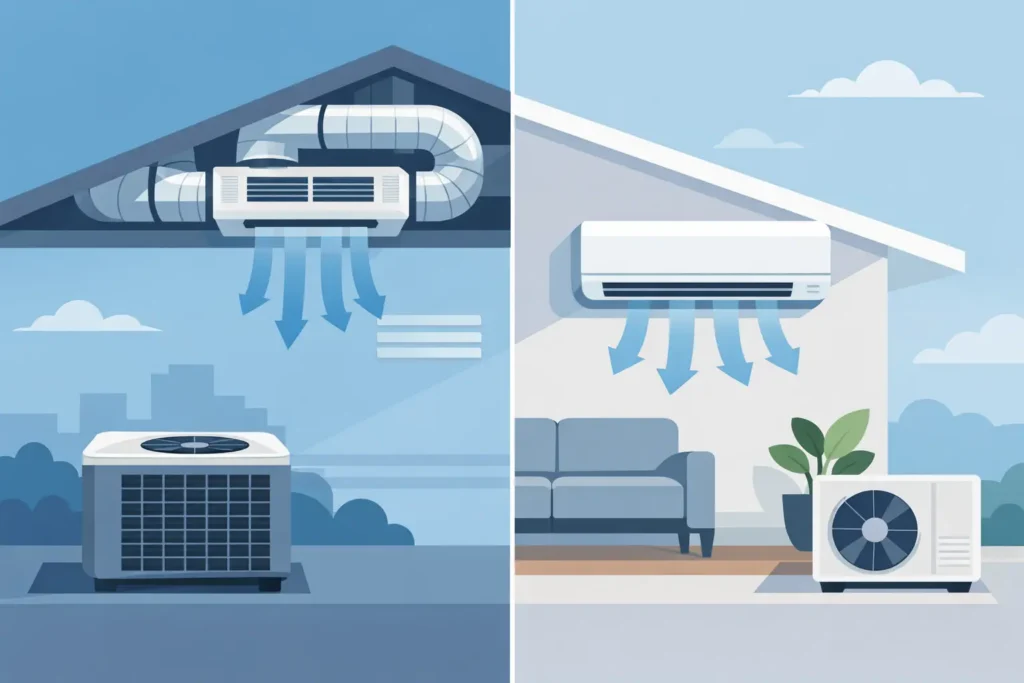
A ducted cooling system, commonly called central air conditioning, uses one indoor air handler and an outdoor condenser. The air handler cools the air and sends it through a network of supply ducts to each room. Return ducts bring air back to the system so the process can continue.
For homes already built with sound, properly sized ductwork, central air is often the most practical path. One thermostat can control the whole house, and the indoor equipment stays largely out of sight. This is especially appealing in homes where homeowners want a traditional, consistent setup without wall-mounted units in occupied rooms.
That said, ducts have a major effect on performance. Leaky ducts, crushed flex duct, poor insulation, undersized returns, and unbalanced supply runs can make a newer air conditioner feel disappointing. A system may run longer than it should, leave bedrooms warm, or struggle to remove moisture. Replacing an outdoor unit without addressing failing ductwork can leave the original comfort problem in place.
How Ductless Mini-Split Cooling Works
A ductless system uses an outdoor condenser connected to one or more indoor air handlers. Each indoor unit cools a specific room or zone and has its own temperature control. Small refrigerant lines and wiring run between the indoor and outdoor equipment, so the installation does not require a full network of ducts.
Ductless mini-splits are often a strong fit for home additions, converted garages, sunrooms, bonus rooms, and older houses without usable duct space. They can also solve a persistent hot-room problem without forcing the central system to work harder for the entire home.
Because each zone operates independently, ductless systems give households more control. You can keep a guest room at a lighter setting while maintaining comfort in the main living area. That can reduce wasted cooling in spaces that sit empty for much of the day.
The trade-off is visibility and placement. Wall-mounted air handlers are functional, but some homeowners prefer the concealed look of central air. Ceiling cassettes and other ductless configurations may be available, though they can add installation complexity and cost. Every indoor unit also needs regular filter cleaning and clear airflow to perform well.
Ducted Versus Ductless Cooling Systems: Key Differences
The biggest difference between ducted versus ductless cooling systems is central control versus room-by-room control. Central air is designed to cool the home as one connected system. Ductless cooling is designed around zones, allowing you to condition only the areas that need it.
Comfort and Temperature Balance
A properly designed ducted system can provide even whole-home comfort. It works especially well when duct runs are sealed, insulated, balanced, and sized for the home. If one room is uncomfortable because of poor duct design or weak airflow, however, a ductless unit may be a targeted and less disruptive solution.
Ductless systems excel when different areas have different cooling needs. A west-facing upstairs room, a home office with computers, or an addition with extra glass may benefit from independent temperature control. This avoids lowering the thermostat for the entire house just to make one difficult room comfortable.
Humidity Control in Coastal South Carolina
Cooling and humidity control go together. In Mount Pleasant and Charleston, an air conditioner has to do more than lower the temperature. It needs to remove enough moisture to keep the home from feeling clammy and to support healthy indoor conditions.
Both system types can manage humidity well when they are correctly sized and installed. Oversizing is a common concern. An oversized unit can cool the air too quickly, shut off early, and miss the longer run time needed for effective moisture removal. Proper load calculations and equipment selection matter more than simply choosing the largest available system.
Central systems can provide strong whole-home humidity management when airflow and ductwork are right. Ductless units can also perform very well in individual areas, but whole-home results depend on the number of zones, unit placement, and how consistently interior doors remain open or closed.
Energy Efficiency
Ductless systems can be highly efficient because they avoid losses from leaky or poorly insulated ducts. Their variable-speed operation also allows many models to adjust output instead of repeatedly cycling at full power. For a lightly used addition or a single troublesome room, that efficiency can be meaningful.
A modern ducted heat pump or air conditioner can also be efficient, particularly when paired with quality ducts and a properly matched indoor system. For a home that already has dependable ductwork, upgrading central equipment may cost less than installing multiple ductless zones while still delivering excellent performance.
Energy savings are not automatic with either option. Setting every ductless zone to a very low temperature, running unused rooms constantly, or operating a central system with major duct leaks can erase expected savings. The way the system is designed and used matters.
Installation and Upfront Cost
Ductless installation generally causes less disruption when a home has no ducts. A technician can connect indoor and outdoor equipment through a small wall opening rather than opening ceilings or walls to create duct paths. That makes mini-splits an attractive option for older homes, additions, and spaces where running ducts would be difficult.
For a full home with several rooms, though, multiple indoor heads and electrical work can make a ductless installation a significant investment. A ducted system may be more cost-effective if existing ducts are in good condition and the equipment can be replaced using the current layout.
If existing ducts are damaged, undersized, or inaccessible, the calculation changes. Extensive duct repairs or replacement can add substantially to a central air project. This is why an honest inspection is more useful than choosing a system based on a general price range.
Maintenance and Service Needs
Both systems need preventative maintenance. Central systems require filter changes, coil cleaning, drain line service, refrigerant checks, and inspection of the blower and electrical components. Ducts should also be evaluated when airflow, dust, or room-to-room comfort becomes a concern.
Ductless indoor units have washable filters that homeowners should clean regularly, often more frequently than a standard central-air filter. Their coils, drain systems, outdoor units, and electrical connections still need professional service. Neglecting filter cleaning can reduce airflow and cause comfort issues surprisingly quickly.
Which System Fits Your Home?
Choose ducted cooling when you have good existing ductwork, want one integrated whole-home system, and prefer equipment that remains mostly hidden. It is also a practical choice when you are replacing an aging central system and your home has generally even temperatures from room to room.
Consider ductless cooling when you are conditioning an addition, garage conversion, detached space, sunroom, or a room that never gets comfortable with the central system. It can also make sense for older homes where adding ducts would require major construction.
In many homes, the answer is not strictly one or the other. A central system can handle the main living areas while a ductless mini-split supports an upstairs suite, bonus room, or addition. This hybrid approach can address the real comfort issue without replacing equipment that still has useful life.
Start With a Real Diagnosis, Not a Sales Pitch
Before making a decision, have the home evaluated as a complete comfort system. That means checking the age and condition of your current equipment, inspecting duct performance, reviewing problem rooms, and determining whether the system is properly sized. It also means asking whether repair, targeted improvement, or replacement offers the best value for your situation.
Mt Pleasant Heating & Air helps homeowners make that decision with experienced diagnostics and practical recommendations. Whether your home needs a duct repair, a central system replacement, or a ductless solution for one difficult space, the right next step is a clear assessment of what is causing the comfort problem and what will fix it for the long term.
Related guides: central air vs. ductless and ductless mini-split vs. heat pump. For professional help, see ductless mini-split service.
Need a hand with this? Mount Pleasant Heating & Air Conditioning has served Lowcountry homes and businesses since 2007, with 24/7 emergency service.
Call (843) 714-0863 or request service online. Related service: ductless mini-split service.