


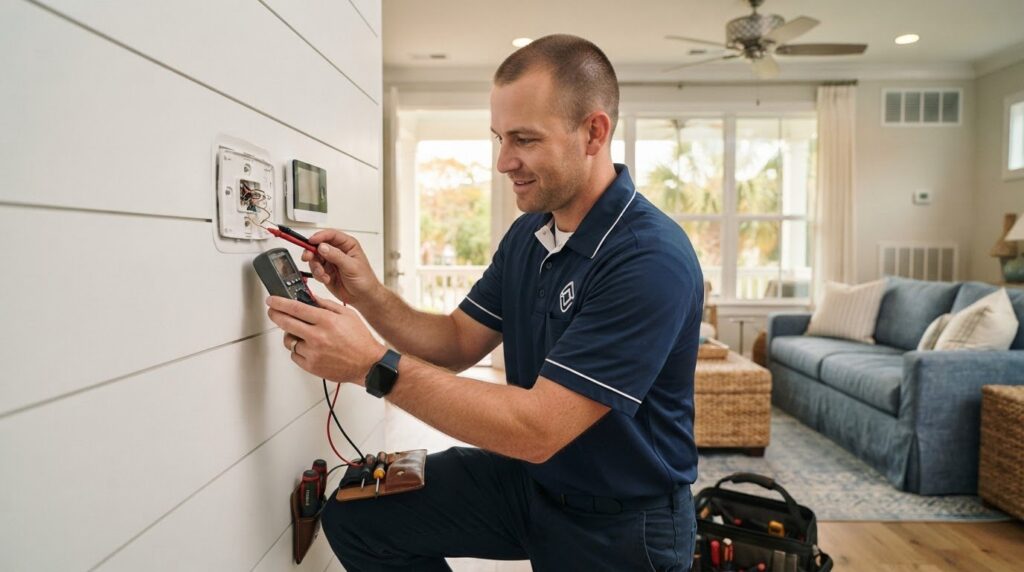
What if the sticky indoor humidity and sudden jump in your power bill aren’t caused by a failing air conditioner, but a quiet miscommunication on your wall? When your cooling cycles run nonstop while your living room stays warm, it’s easy to worry that your entire HVAC setup is collapsing. Lowcountry heat and coastal moisture put immense strain on every component, making dependable thermostat repair Mount Pleasant homeowners count on essential for catching minor control glitches before they cause major system wear.
You shouldn’t have to guess whether a miscalibrated sensor or faulty wiring is driving up your monthly utility costs, nor should you face high-pressure replacement pitches when a straightforward fix is all that’s required. In this guide, you will discover how to identify thermostat malfunctions quickly, restore dependable climate control on the first visit, and weigh the real value of repairs versus smart upgrades. We will explore Lowcountry-specific troubleshooting signs, diagnostic testing protocols, and practical steps to bring lasting comfort back to your living spaces.
Key Takeaways
- Recognize early warning signs of control failure, like short-cycling and unresponsive displays, before they put undue strain on your cooling system.
- Understand how coastal humidity and interior wall drafts corrode sensitive wiring and distort Lowcountry temperature readings.
- Discover when dependable thermostat repair mount pleasant homeowners trust involves straightforward recalibration or terminal fixes rather than an expensive equipment replacement.
- Learn what to expect during a professional diagnostic visit, including 24-volt circuit checks, wiring tests, and heat pump valve verification.
- Make confident, informed decisions for your home comfort with transparent troubleshooting that prioritizes practical repairs over sales pressure.
Signs Your Mount Pleasant Home Needs Immediate Thermostat Repair
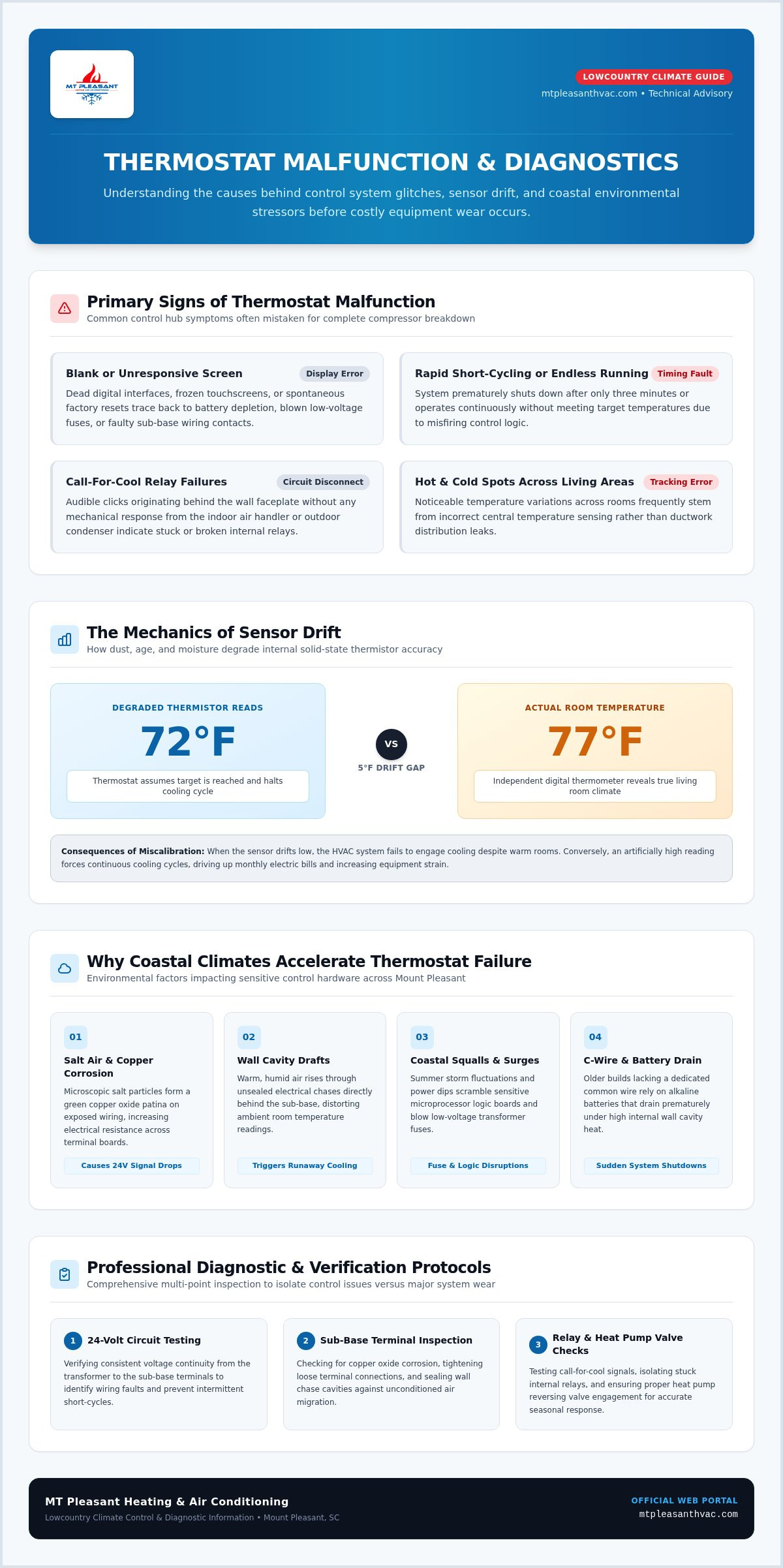
A sudden loss of cooling rarely means your entire outdoor unit has collapsed. Often, the breakdown stems from the small control hub mounted on your hallway wall. When control hardware acts up, it sends chaotic signals to your system, leaving your living spaces stuffy and your energy bills climbing. Knowing whether you need a quick control adjustment or a major equipment overhaul saves both time and unnecessary worry. For dependable how thermostats work insight and targeted thermostat repair mount pleasant homeowners rely on, look out for these direct symptoms:
- Blank or unresponsive screens: A dead digital interface, frozen touchscreen, or random factory reset points to battery exhaustion, blown low-voltage fuses, or failed sub-base connections.
- Endless running or short-cycling: If your system shuts down after three minutes or runs continuously without ever meeting your set temperature, the control logic is misfiring.
- Call-for-cool failures: Hearing a click without any response from the air handler or outdoor condenser signals broken control circuit relays.
- Noticeable hot and cold spots: Wide temperature swings between rooms often stem from faulty room-temperature tracking rather than duct leaks, though understanding what is a damper in your ductwork can help rule out airflow restrictions as a contributing cause.
Recognizing Sensor Drift and Temperature Discrepancies
Inside digital controls, a solid-state component called a thermistor tracks ambient heat. When dust, age, or moisture degrades this sensor, it experiences drift. The wall display might show 72 degrees, but an independent digital thermometer placed alongside reads 77. Because the sensor believes your home is already cool, it fails to trigger the cooling cycle. Alternatively, it may read artificially high, forcing your air conditioner to run endlessly and driving up your electric bill.
Electrical Short Cycles and Communication Lags
Rapid cycling usually traces back to electrical signaling faults rather than a dead compressor. Loose terminal screws behind the faceplate disrupt the steady 24-volt circuit feeding back to your indoor air handler. When contact drops intermittently, your system shuts down abruptly, only to restart seconds later. While a loud mechanical clunk outside suggests an outdoor contactor issue, faint clicking behind the wall without any system response points directly to stuck relays inside the control unit itself. Securing professional thermostat repair mount pleasant technicians provide helps isolate these tiny switches before short-cycling damages your expensive compressor motor.
Why Thermostats Fail in the Lowcountry Climate
Living near the coast means dealing with persistent moisture, salt air, and sudden summer thunderstorms. While most homeowners know how coastal weather beats up outdoor condenser coils, few realize what it does to the electronics inside their walls. Warm, moisture-laden air migrates through exterior framing and interior partitions. When that damp air meets delicate low-voltage electrical terminals, trouble follows quickly. Securing dependable thermostat repair mount pleasant homeowners rely on often starts with understanding these environmental stressors.
Mount Pleasant homes face distinct microclimates, from Old Village cottages to newer builds along Highway 17. In unsealed wall cavities, hot, humid air travels upward through electrical chases directly behind your thermostat sub-base plate. This unconditioned draft fools internal sensors into misreading the room’s true climate, triggering calls for cooling that never shut off.
The Impact of High Humidity and Salt Air on Wiring
Microscopic salt particles carried inland by coastal breezes settle onto exposed copper wiring. Over time, high ambient humidity reacts with these bare conductors, forming a green patina of copper oxide. This thin film increases electrical resistance across your control board. As terminal screws corrode, the delicate 24-volt current drops, causing intermittent communication errors between the sub-base and your indoor air handler.
Power Fluctuations, Dead Batteries, and C-Wire Deficiencies
Coastal squalls frequently cause brief power dips and surges. These electrical blips can scramble modern logic boards or blow the low-voltage fuse protecting your transformer. If your unit relies solely on alkaline backup batteries, intense heat inside wall cavities can cause early battery drainage, resulting in unexpected system shutdowns.
Older Lowcountry homes also frequently lack a dedicated common wire, or C-wire. Without this dedicated power return, advanced controls must “power steal” from the heating or cooling circuit. This setup works poorly on heat pumps and multi-stage systems, leading to phantom clicks, screen flickering, and communication dropouts. Upgrading older wiring configurations to support ENERGY STAR certified smart thermostats ensures stable power delivery without risking erratic operational errors.
Repairing vs. Replacing Your Thermostat: Making the Right Choice
When climate control acts up, many contractors immediately push for expensive new equipment. But does your wall unit actually need the trash bin? In many Lowcountry homes, it doesn’t. Deciding between a minor fix and a brand-new interface comes down to component integrity, device age, and system matching. Honest thermostat repair mount pleasant technicians provide focuses on restoring what works before recommending an upgrade.
Consider this practical decision framework before making any decisions:
- Device Age: Basic digital models under five years old usually just need servicing. Mechanical mercury switches or units older than ten years typically lack the precision modern equipment requires.
- Symptom Scope: Bad wiring, oxidized contacts, or slight calibration drift are easily repaired on site. Cracked housing, fried logic chips, or dead display lines generally warrant a replacement.
- Equipment Staging: If you recently upgraded your HVAC machinery, an older thermostat may fail to activate high-efficiency stages, wasting system capacity.
When a Professional Repair Solves the Problem
Professional adjustments often resolve control failures completely. Trimming back corroded copper to fresh bare metal, tightening loose terminal blocks, or resetting jumper pins instantly restores power integrity. Technicians can also enter advanced software menus to apply a calibration offset, aligning the display with room temperature without swapping hardware. Similarly, replacing a blown 3-amp fuse inside your indoor air handler or tightening the 24-volt transformer leads often brings a supposedly dead wall unit straight back to life.
When Upgrading to a Smart Thermostat Delivers Superior Value
There are times when replacement delivers far better long-term reliability. Older manual controls cannot modulate auxiliary heat strips during mild coastal winters, leading to unnecessary power consumption. Modern smart platforms learn household schedules, adjust for outdoor humidity levels, and let you tweak settings from Sullivan’s Island or downtown Charleston via smartphone. Before making the switch, reviewing a detailed smart thermostat setup mount pleasant homeowners guide helps ensure your new device is compatible with your existing wiring and equipment before installation begins. Proper configuration is vital if your home relies on dual-capacity compressors; review our guide on heat pump service in Mount Pleasant for multi-stage efficiency insights that help match your thermostat to advanced equipment logic.
The Professional Thermostat Diagnostic and Repair Process
When you schedule a service visit, you deserve to know exactly what the technician is doing behind the faceplate. Systematic troubleshooting removes the guesswork, protecting sensitive components and ensuring an accurate solution. Rather than swapping parts blindly, experienced technicians follow a methodical checklist to pinpoint whether a control board, wiring harness, or external relay is to blame. Choosing professional thermostat repair mount pleasant residents rely on guarantees that every test follows strict manufacturer protocols.
The evaluation starts with physical mounting. A digital level confirms proper alignment, which remains essential for older models with internal tilt mechanisms. Next, technicians inspect the sub-base for plaster dust, insect debris, or coastal salt buildup that could create high-resistance bridges between terminal pins.
Low-Voltage Circuit Testing and Safety Checks
Before pulling wires, technicians switch off high-voltage disconnects to shield the indoor air handler’s step-down transformer from unintended shorts. Using a calibrated digital multimeter, the technician measures the alternating current across the red power wire (R) and common wire (C), confirming a steady 24 to 28 volts. If power reads zero, the focus shifts to locating a blown 3-amp or 5-amp control fuse on the integrated furnace board, which often trips during storm surges.
Verifying Signal Transmission to the Outdoor Unit
Once base power is confirmed, the technician tests continuous signal transmission. By bridging the R terminal to the yellow cooling terminal (Y), they measure whether 24 volts reaches the outdoor condenser contactor switch. If voltage appears at the wall but drops before the outdoor unit, broken or pinched copper inside the crawlspace or attic is isolated and repaired.
For heat pump installations, testing the orange or brown reversing valve wire (O/B) is equally critical. If that relay fails to energize, your system might blast heat during a humid July afternoon. If these signals prove fully functional yet your outdoor system remains inactive, the issue may lie within the cooling unit itself. In those cases, you can arrange dedicated AC repair in Mount Pleasant, SC to resolve stubborn mechanical or refrigerant failures. A technician may also inspect your ductwork components — including understanding what is a damper and whether a stuck or failed damper is restricting airflow to specific zones — to ensure the full system is operating as intended.
Ready to restore precision to your home climate? You can easily schedule an expert thermostat inspection with our local team today to get your cooling cycles running smoothly again.
Why Choose MT Pleasant Heating & Air Conditioning for Thermostat Service
Restoring balanced comfort in your home shouldn’t come with stressful sales pitches. When your wall control acts up during a sweltering July afternoon, you need straight answers and practical solutions. At MT Pleasant Heating & Air Conditioning, we treat your home like our own. As a locally owned contractor deeply familiar with Lowcountry coastal humidity, we understand how local weather stresses delicate electronics. That local insight allows us to deliver accurate thermostat repair mount pleasant homeowners can rely on without delay.
Our experienced technicians service everything from traditional mechanical dials and standard digital interfaces to modern smart platforms. Whether your home features historic framing in the Old Village or a multi-zone layout in Park West, we know how local home designs affect wiring paths and sensor behavior.
Our Commitment to Honest, Solution-Oriented Service
We believe in repairing equipment whenever practical rather than pushing for complete system replacements. Before turning a single screwdriver, our technician explains exactly what the multimeter readings show and walks you through every viable repair option. You stay completely in control of the decision. There are no high-pressure quotas or surprise recommendations, just neighborly guidance focused on restoring dependable cooling. We treat your property with complete care, keeping work areas clean and ensuring your climate control operates safely before wrapping up.
Schedule Fast Thermostat Diagnostics in Mount Pleasant Today
Losing control of your indoor temperatures quickly turns a comfortable home into an unlivable space. That is why we offer 24/7 emergency repair response throughout Mount Pleasant and Charleston. Whether your cooling system shuts down on a weekend morning or stops responding late at night, our local dispatch team responds promptly to get your indoor air moving again.
Scheduling is straightforward and tailored around your daily family schedule. Contact our friendly local team today to set up your comprehensive thermostat diagnostic visit and enjoy dependable comfort all season long.
Take Control of Your Lowcountry Home Comfort Today
Living along the South Carolina coast shouldn’t mean battling erratic indoor temperatures or bracing for mystery utility spikes. Persistent cycling, reading discrepancies, and blank screens usually point to isolated control faults rather than total equipment failures. Thorough low-voltage circuit testing, wire restoration, and precise sensor recalibration often solve these frustrations quickly, protecting your broader HVAC system from excessive coastal wear without forcing an expensive replacement.
When you need dependable thermostat repair mount pleasant homeowners count on, our experienced team provides 24/7 emergency repair response throughout Mount Pleasant and Charleston. Backed by comprehensive multi-point diagnostics, we focus on practical repairs first, eliminating high-pressure sales pitches to keep your household cool and comfortable. Schedule reliable thermostat repair in Mount Pleasant with MT Pleasant Heating & Air Conditioning today and restore complete peace of mind to your living space.
Frequently Asked Questions
Is it dangerous to attempt DIY thermostat wiring repairs without professional training?
While low-voltage wires carry only 24 volts and rarely pose a life-threatening shock hazard, DIY attempts carry significant mechanical risks. Accidental contact between hot and common wires instantly blows the control fuse on your indoor air handler board or burns out the transformer. In older Mount Pleasant homes, line-voltage systems carrying 120 or 240 volts can cause severe electric shock. Calling a professional protects both your safety and your HVAC electronics.
Can a faulty thermostat cause an air conditioning unit to freeze up?
Yes, a malfunctioning thermostat can easily cause your evaporator coil to freeze into a solid block of ice. If the temperature sensor fails to register that the room reached your target temperature, it signals the outdoor unit to run indefinitely. Continuous operation without cycling causes internal coil temperatures to plummet below 32 degrees, freezing condensation. Prompt thermostat repair mount pleasant homeowners schedule prevents this ice buildup from choking airflow and straining the compressor.
What happens if my thermostat loses its continuous C-wire power supply?
Losing common-wire power causes modern smart thermostats to behave erratically. The device often drops its Wi-Fi signal, reboots randomly, or fails to trigger secondary heating stages. Some units attempt to “power steal” current from the cooling circuit when the C-wire disconnects, which can cause outdoor heat pumps or contactors to buzz loudly and cycle unpredictably. Restoring a stable 24-volt common circuit prevents these power dropouts and protects sensitive microprocessor logic.
How do I know if the problem is my thermostat or my HVAC unit?
You can perform a quick diagnostic check by adjusting your thermostat five degrees above or below the current room temperature. If you hear a click at the wall but the indoor blower and outdoor condenser remain completely silent, the issue is often a failed control relay or wiring issue. However, if the system turns on but blows room-temperature air, the breakdown typically points to mechanical issues like low refrigerant or a failed capacitor.
Can a malfunctioning thermostat significantly increase my monthly electric bill?
It certainly can. When a thermostat’s internal sensor drifts, it can force your cooling system to run extended cycles trying to satisfy an artificial setpoint. In dual-fuel or heat pump systems, a misconfigured control might accidentally engage expensive electric emergency heat strips in mild weather. Correcting sensor calibration and verifying wiring ensures your heating and cooling equipment only runs when truly necessary, keeping monthly energy bills predictable.
Why is my thermostat clicking repeatedly without turning on the heat or AC?
Repeated clicking indicates that the internal relays are trying to complete an electrical circuit, but downstream power is missing. This usually happens when an outdoor contactor fails, a safety float switch trips in your drain pan, or a low-voltage circuit fuse blows. Seeking professional thermostat repair mount pleasant technicians provide ensures the low-voltage communication loop is tested from wall to unit, isolating the open connection quickly.
How long does a typical professional thermostat diagnostic and repair service take?
A standard diagnostic visit typically takes between 45 and 90 minutes. During this window, an experienced technician measures terminal voltages, tests continuous signal transmission to outdoor components, checks reversing valve communication, and recalibrates sensor offsets. If simple wire re-stripping, terminal tightening, or sub-base cleaning solves the issue, the technician completes the entire repair within that first visit, getting your indoor climate back under control quickly.