
Is your air conditioner actually working for you, or are you just paying for the privilege of feeling clammy every July? We all know that specific Lowcountry feeling where the air is so thick you can practically wear it. You expect your home to be a cool sanctuary, but instead, the thermostat stays stuck while your power bill climbs higher than the midday sun. Investing in high efficiency HVAC Charleston systems might feel like a big step, but in our unique climate, it is often the only way to stay truly comfortable.
Owning a coastal home comes with its own HVAC worries. You want a system that lowers your monthly energy costs without being destroyed by salt air in just a few years. It is a common frustration, and you deserve a solution that provides genuine confidence. This article shows you how high-efficiency technology conquers Charleston humidity and provides a crisp, dry indoor environment. We will preview the latest coastal-grade features, explain how these units survive the salt air, and help you decide if the energy savings make sense for your budget.
Key Takeaways
- Understand the transition to SEER2 ratings and why these energy standards are specifically designed to handle the Southern heat.
- Learn how high-efficiency HVAC systems use variable-speed technology to eliminate that “clammy” indoor feeling while resisting salt air corrosion.
- Learn why the federal tax credit for HVAC upgrades ended after 2025, and which rebates may still help.
- Master the “50% Rule” to help you decide when a professional AC repair makes sense and when a high-efficiency replacement is the better long-term choice.
- Find out how modern compressor technology acts like cruise control for your home, providing consistent comfort without the spike in electricity bills.
What Defines High-Efficiency HVAC in Charleston?
Have you noticed how many labels are stuck to the side of a new AC unit these days? It can feel like alphabet soup. When we talk about high-efficiency HVAC Charleston homeowners need to understand that the goalposts have moved. Today, a “standard” unit from five years ago might not even meet the legal minimum for installation. The technology has evolved to meet stricter federal rules, but more importantly, it has evolved to handle our specific climate better.
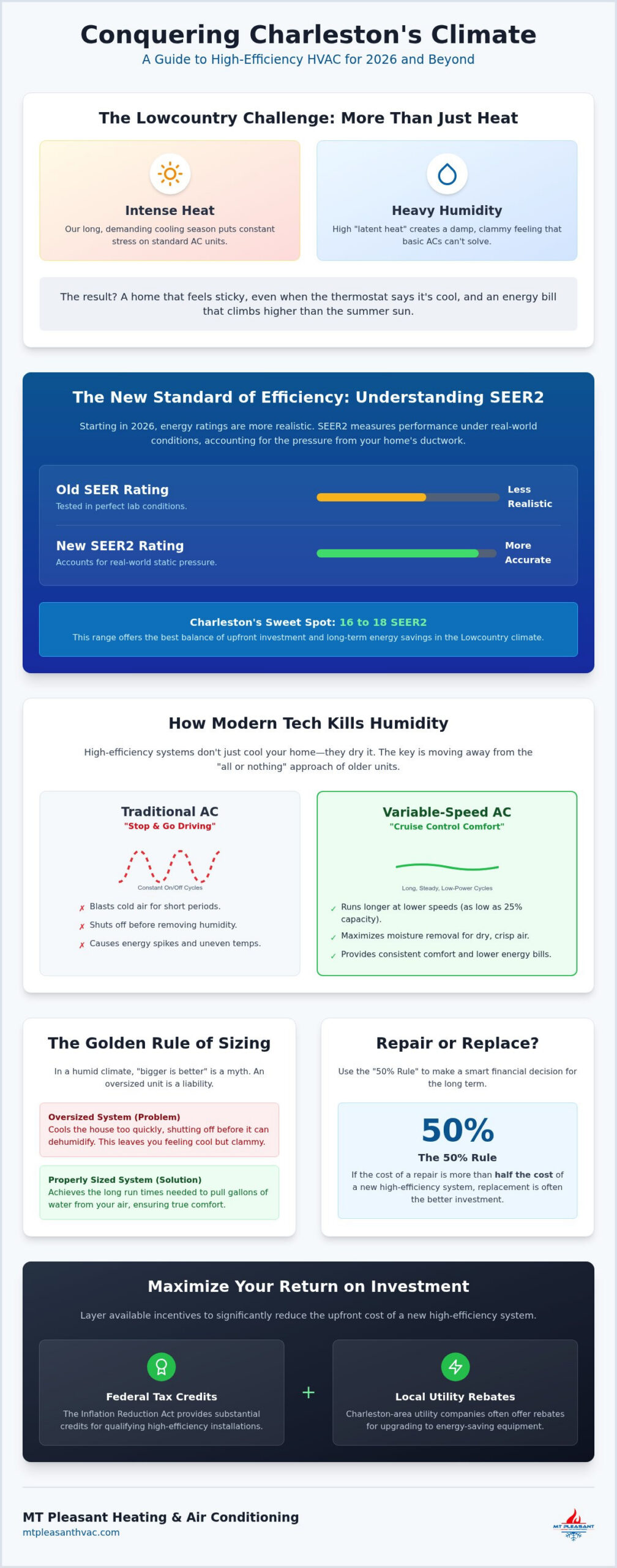
The biggest change is the shift to SEER2. Why does that extra “2” matter to you? Old SEER ratings were tested in perfect lab conditions that didn’t account for the actual pressure of your home’s ductwork. SEER2 tests are more rigorous. They reflect how a system performs when it’s actually pushing air through your vents on a 95-degree day in Mt. Pleasant. This higher standard ensures that the efficiency you’re promised on the box is closer to what you actually experience in your living room.
Charleston’s heat is unique because of “latent heat,” which is just a professional way of describing our heavy humidity. A basic unit might drop the temperature quickly, but it often leaves the air feeling heavy and damp. High-efficiency systems are designed to run longer, slower cycles. This allows them to pull gallons of water out of your indoor air every single day, solving the “sticky house” problem that standard units often ignore.
Understanding SEER2 and HSPF2 Ratings
Think of SEER2 as the “miles per gallon” for your cooling system. The higher the number, the less you pay the utility company to keep your home comfortable. SEER2 is defined as the ratio of cooling output to energy consumed under specific pressure conditions. While cooling is our main focus, don’t ignore HSPF2. Our winters are damp and chilly, even if they’re short. A high HSPF2 rating ensures your heat pump doesn’t work overtime during those gray January weeks, keeping your energy bills predictable year-round.
The Role of the Federal Department of Energy (DOE)
The DOE sets different rules for the South because our cooling season is so demanding. Current standards are stricter here in the Southeast than in cooler northern states. Manufacturers have responded by building units with larger coils and smarter motors. This is also why “matched systems” are so vital now. You can’t simply swap the outdoor unit and keep an old indoor coil. Both halves of the system must be engineered to work together to hit those legal efficiency targets and provide the comfort you expect.
For most of our neighbors, the 16 to 18 SEER2 range is the current sweet spot. It provides the best balance between the initial purchase price and the monthly savings you’ll see on your power bill. While you can go higher, this range typically offers the most reliable return on your investment in the Lowcountry.
The Technology: How Efficiency Masters the Lowcountry Heat
Think of a traditional air conditioner as a car that only has two speeds: zero and seventy miles per hour. Every time your home gets a little warm, the system floors the accelerator to cool things down, then slams on the brakes once it hits the target temperature. This constant stopping and starting is exactly why your electric bill spikes in August. By contrast, high-efficiency HVAC systems utilize technology that acts more like cruise control. They adjust their output in small increments to match the heat load of your home exactly.
For budget-conscious homeowners, two-stage compressors offer a helpful middle ground. These units have a “high” setting for those brutal 98-degree afternoons and a “low” setting for milder days. However, the true masters of comfort are variable-speed systems. Because these units run for longer cycles at lower power, they are significantly better at removing humidity. A system that runs for twenty minutes at low power will pull far more moisture out of your air than a standard unit that blasts for five minutes and shuts off. If you are planning a new AC installation, we can help you size the system perfectly to ensure you get these dehumidification benefits.
It is a common mistake to think that “bigger is better” when buying a new unit. In our coastal climate, an oversized high-efficiency system is actually a liability. If the unit is too powerful, it will cool your home so quickly that it never has the chance to dry the air. You end up with a house that is 72 degrees but still feels damp and “clammy.” Proper sizing is the only way to ensure the technology actually does its job.
Variable-Speed Compressors: The Humidity Killers
Variable-speed compressors can operate at as little as 25% of their total capacity. This allows them to sip electricity while providing a continuous flow of treated air. This constant movement eliminates the frustrating hot and cold spots often found in older Charleston homes. You will also notice how quiet they are. Without the heavy “thump” of a single-stage compressor kicking on, these systems hum along almost imperceptibly in the background.
Blower Motors and Airflow Management
The efficiency isn’t just in the outdoor unit. Modern systems use Electronically Commutated Motors (ECM) in the indoor blower. These smart motors adjust their speed automatically to overcome ductwork restrictions or dirty filters. Because the fan runs more consistently at lower speeds, your air is constantly passing through your filtration system. This leads to a significant improvement in indoor air quality, which is a breath of fresh air during pollen season.
The Charleston Factor: Humidity and Salt Air Challenges
Living in the Lowcountry means accepting that the air is often as salty as the ocean. While we love the breeze coming off the harbor, your air conditioner definitely doesn’t. If you’ve ever walked into your home and felt like the air was “heavy” even though the thermostat said 72 degrees, you’ve experienced the “Sticky House” syndrome. This happens when a system handles the temperature but fails to manage the moisture. Investing in high-efficiency HVAC equipment is about more than just numbers on a page; it is about surviving the local environment.
Charleston’s dew point is notoriously high, often hovering in the 70s for weeks at a time. This puts an incredible workload on your system. A standard unit might cycle off before it ever reaches the dew point on the indoor coil. This leaves your home feeling like a swamp. High-efficiency units are designed for these exact conditions, running longer cycles at lower speeds to squeeze every drop of moisture out of your indoor air.
This steady approach is the only way to keep your home feeling crisp when the humidity outside is at 90%. The same salt air and humidity challenges that affect residential systems are equally demanding on businesses throughout the Lowcountry, making commercial HVAC repair in Charleston, SC just as critical for keeping employees and customers comfortable year-round.
Conquering Lowcountry Humidity
There is a major difference between sensible cooling and latent cooling. Sensible cooling is what you see on the thermostat, while latent cooling is the removal of water from the air. High-efficiency systems excel at latent cooling because they don’t just blast cold air and quit. They act as whole-home dehumidifiers, keeping your floors from feeling tacky and your bedding from feeling damp. This consistent moisture removal is your first line of defense against mold and mildew growth in your closets and corners.
Protecting Your Investment from Salt Air
If you live on Sullivan’s Island or Isle of Palms, you know that salt air is a silent killer for mechanical equipment. It eats through standard aluminum fins in a matter of years, causing the metal to crumble like a saltine cracker. When choosing a high-efficiency unit, look for “Coastal Grade” features. These often include phenolic coatings, which provide a specialized barrier against salt spray.
We also recommend traditional “Tube and Fin” designs over “Microchannel” coils for homes near the water. They are generally easier to clean and more resistant to the specific type of corrosion we see in Mt. Pleasant. To keep your system running, a simple monthly rinse of the outdoor condenser with fresh water can wash away salt deposits before they take hold.
Calculating ROI: Rebates, Tax Credits, and Energy Savings
Is the higher price tag of a high-efficiency system actually worth it? It is the question we hear most often from our neighbors in Mt. Pleasant. While the initial investment for high-efficiency HVAC is higher than a standard unit, the financial math has shifted significantly. Between lower monthly utility bills and aggressive government incentives, the “payback period” is shorter than it has ever been.
Most Charleston residents see their cooling costs drop by 20% to 40% after upgrading from an older system to a modern high-efficiency model. In a city where the AC runs for eight or nine months of the year, those monthly savings add up fast. Over the lifespan of the unit, the energy savings alone often cover the entire cost difference of the upgrade. You aren’t just buying a machine; you are pre-paying for lower energy bills for the next decade.
What Happened to the Federal Tax Credit
For several years, the federal 25C Energy Efficient Home Improvement Credit helped offset the cost of qualifying heat pumps and central air conditioners. That credit ended for equipment installed after December 31, 2025, so new installations no longer qualify. Utility rebates and manufacturer promotions change throughout the year, so ask us what is currently available when you compare systems.
Local Rebates and Financing Options
Dominion Energy offers its own set of incentives to help Charleston homeowners lower their energy footprint. These rebates often require the system to meet specific SEER2 and HSPF2 thresholds to qualify. Navigating these technical requirements can be tricky, but a professional HVAC installation in Charleston, SC ensures that your new equipment is properly matched and documented for rebate compliance.
We also know that a sudden AC failure isn’t always in the budget. That is why low-interest financing has become a popular way to bridge the gap. It allows you to start saving on your energy bills immediately while paying for your high-efficiency HVAC system over time. If you want to see which specific rebates and credits apply to your home, contact our team today for a clear and transparent breakdown of your potential savings.
Making the Choice: Repair or High-Efficiency Replacement?
Is that strange rattling sound from your outdoor unit a minor fix or the beginning of the end? When your system fails on a humid July afternoon, the pressure to make a quick decision is intense. You might worry that a technician will push for an expensive new unit when a simple fix would do.
At MT Pleasant Heating & Air, we believe in a “Fix it First” philosophy. Before we ever discuss the benefits of high-efficiency HVAC installations, we want to see if your current system has a few good years of reliable service left. Scheduling professional HVAC system diagnostics in Charleston is the best way to get an honest, fact-based picture of your equipment’s condition before committing to any major decision.
How do you know when to stop pouring money into an old unit? We suggest using the 50% Rule as a practical guide. If the cost of a single repair is more than half the value of the system, it is usually time to consider a replacement. This is especially true if your unit is approaching the end of its expected life.
While a system in a dry climate might last 20 years, the reality of our coastal environment is different. Salt air and extreme humidity typically limit a local system’s lifespan to about 10 to 12 years. If you are facing a major repair on a unit in that age range, investing that money into a modern, high-efficiency model is often the smarter financial path for your home.
When to Stick with a Repair
Not every breakdown requires a forklift and a new unit. Many common issues are actually quite simple to resolve. A failed capacitor, a clogged condensate line, or a glitchy thermostat can bring your comfort to a halt, but these are routine fixes. Professional AC repair in Mount Pleasant is often the most cost-effective way to restore your home’s sanctuary without a major capital expense. We specialize in identifying these minor issues quickly to save you from unnecessary stress and spending.
The MT Pleasant Heating & Air Difference
We approach every service call as a “local team” rather than a salesperson. Our team focuses on precise system sizing and detailed load calculations to ensure your home is neither under-cooled nor over-cooled. We never push for upgrades you don’t need, and we value long-term relationships over quick sales. If you are unsure about the health of your system, you can schedule a no-pressure consultation to get an honest assessment of your equipment’s condition.
If you do decide to upgrade, we also look beyond the box. We check your ductwork and attic insulation to ensure your home can actually hold the cool air your new system produces. Even the best high-efficiency HVAC system will struggle if your energy is leaking out through poor seals or thin insulation. We make sure the entire environment is ready to support your new investment.
Frequently Asked Questions
Is high-efficiency HVAC really worth it for Charleston’s climate?
High-efficiency systems are specifically designed to handle the intense workload of a Lowcountry summer. Because our cooling season lasts for the majority of the year, the energy savings accumulate much faster than they would in cooler climates. These units don’t just lower your temperature; they transform your indoor environment by actively managing the heavy moisture that makes 75 degrees feel like 80. For most Charleston homeowners, the improved comfort and lower bills make it a wise long-term investment.
How much can I actually save on my energy bill with a high-efficiency unit?
Most homeowners in the Lowcountry see a reduction of 20% to 40% on their monthly cooling costs after upgrading to a high-efficiency HVAC system. If your current unit is over a decade old, you are likely using significantly more power than necessary to stay cool. While exact savings vary based on your home’s insulation and thermostat habits, the cumulative impact over a ten-year lifespan often offsets the initial cost of the premium equipment.
What is the best SEER2 rating for a home in Mount Pleasant?
For most residents in Mount Pleasant, a rating between 16 and 18 SEER2 provides the most reliable balance of performance and price. While you can find units with higher ratings, the incremental energy savings often don’t justify the significantly higher upfront cost in our specific region. Staying within this “sweet spot” ensures you get the dehumidification benefits of modern technology without overpaying for efficiency that your home might not fully utilize.
Does high-efficiency HVAC help with indoor humidity?
Yes, high-efficiency systems are essentially whole-home dehumidifiers because they utilize variable-speed compressors. Unlike standard units that blast cold air and quickly shut off, these systems run longer cycles at lower speeds. This allows the indoor coil to stay cold enough to pull gallons of water out of your air every day. You’ll notice your floors feel drier and your home loses that “clammy” sensation that often plagues older Charleston houses.
Are there tax credits for high-efficiency HVAC?
Not from the federal government anymore. The 25C tax credit, which covered 30% of the cost of qualifying heat pumps and central air conditioners (up to $2,000 and $600), ended for equipment installed after December 31, 2025. It is still worth asking about utility rebates and manufacturer promotions, which change throughout the year.
Need a hand with this? Mount Pleasant Heating & Air Conditioning has served Lowcountry homes and businesses since 2007, with 24/7 emergency service.
Call (843) 714-0863 or request service online. Related service: AC installation and replacement.