What if that strange rattling sound in your attic isn’t a sign you need a five figure replacement, but just a simple, overlooked adjustment? It’s a common fear for many Lowcountry homeowners. You notice the humidity climbing or the air feels a bit warmer than usual; suddenly, the anxiety of a total system failure during a July heatwave takes over. We understand that feeling of being at the mercy of your equipment. That’s why professional HVAC system diagnostics Charleston are designed to give you the facts, not a sales pitch. You deserve to know exactly what’s happening inside your unit without the pressure of unnecessary upgrades.
In this guide, we’ll show you how a thorough diagnostic visit identifies the actual root cause of performance issues, from salt air corrosion to failing capacitors. You’ll discover how these targeted checks can lower your monthly energy bills and extend the life of your unit through the peak of the season. We’ll walk you through what to expect during a professional inspection, how we prioritize fixing what’s broken, and how to gain total confidence about your home’s comfort. By understanding the health of your system, you can make informed decisions that protect both your wallet and your family’s cooling.
Key Takeaways
- Learn the critical difference between a routine tune-up and a data-driven diagnostic so you can address performance issues without paying for unnecessary services.
- Discover how technicians use non-invasive tools like thermal imaging during hvac system diagnostics charleston to pinpoint hidden leaks and electrical hotspots.
- Identify common warning signs like short-cycling and unusual mechanical noises that indicate your system is struggling to keep up with the Lowcountry humidity.
- Get a clear framework for the “Rule of 5,000” to help you decide if a repair or a replacement is the most cost-effective path forward for your home.
- Understand how transparent reporting and hard data protect you from high-pressure sales tactics while ensuring your home’s comfort is restored quickly.
What is a Professional HVAC System Diagnostic?
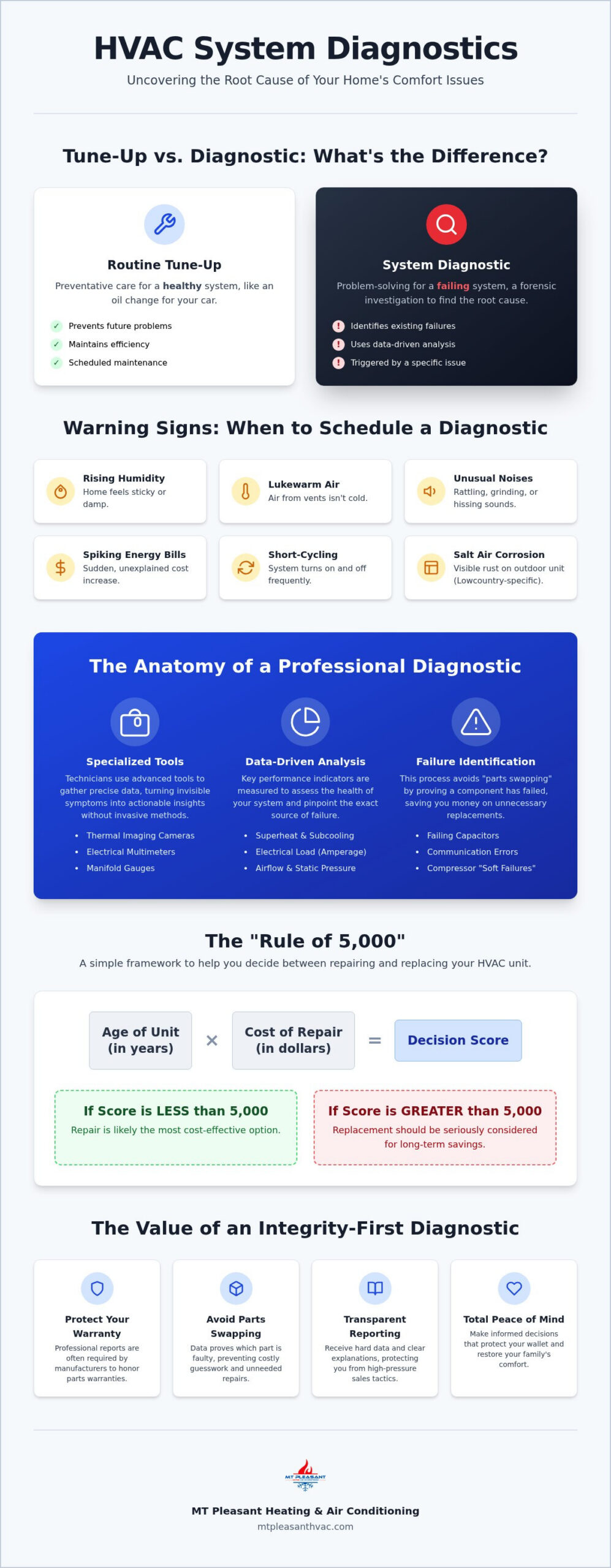
Think of an HVAC diagnostic as a forensic investigation into your home’s comfort. While many homeowners use the terms “tune-up” and “diagnostic” interchangeably, they serve very different purposes. A routine maintenance visit is a preventative measure, much like an oil change for your car, designed to keep a healthy system running smoothly. In contrast, hvac system diagnostics charleston are problem-solving missions triggered when something is already wrong. Whether your vents are blowing lukewarm air or your energy bills have spiked without explanation, a diagnostic is the data-driven process used to find the mechanical or electrical root cause of the failure.
This level of analysis requires more than just a quick look under the hood. Professional diagnostics demand specialized training and, ideally, NATE certification. This ensures the technician understands the complex relationship between airflow, refrigerant pressures, and the HVAC control system that regulates your home’s climate. The goal is to move past the symptoms and identify exactly why a component failed, which prevents the same issue from returning a week later.
Diagnostic vs. Troubleshooting: Why Expertise Matters
Troubleshooting is the simple act of identifying a symptom. If your outdoor fan isn’t spinning, troubleshooting tells you the fan is off. However, a professional diagnostic identifies the “why” behind the failure. Is the motor dead, or is a five dollar capacitor simply failing to provide the necessary start-up kick? Identifying the specific electrical or mechanical fault prevents “parts swapping.” This is a common mistake made by amateurs where they replace expensive components one by one until the system finally starts. A true diagnostic uses precise tools to prove a part is bad before it’s ever removed, saving you from paying for repairs you don’t actually need.
The Standards of a Charleston HVAC Evaluation
In the Lowcountry, our environment dictates a specific set of diagnostic standards. Because of our high humidity and salt air, a proper evaluation must be comprehensive. It should include:
- Dual-Component Inspection: Testing both the indoor air handler and the outdoor condenser to check for communication errors.
- Electrical Load Testing: Measuring the actual amperage draw of motors to catch “soft failures” before they become total breakdowns.
- Warranty Protection: Documenting the failure according to industry standards. This is vital because most manufacturers require professional diagnostic reports to honor parts warranties.
By sticking to these rigorous standards, we ensure that your system isn’t just “fixed” for the day, but restored to its peak efficiency for the long haul.
The Anatomy of a Diagnostic: Tools and Techniques for the Lowcountry
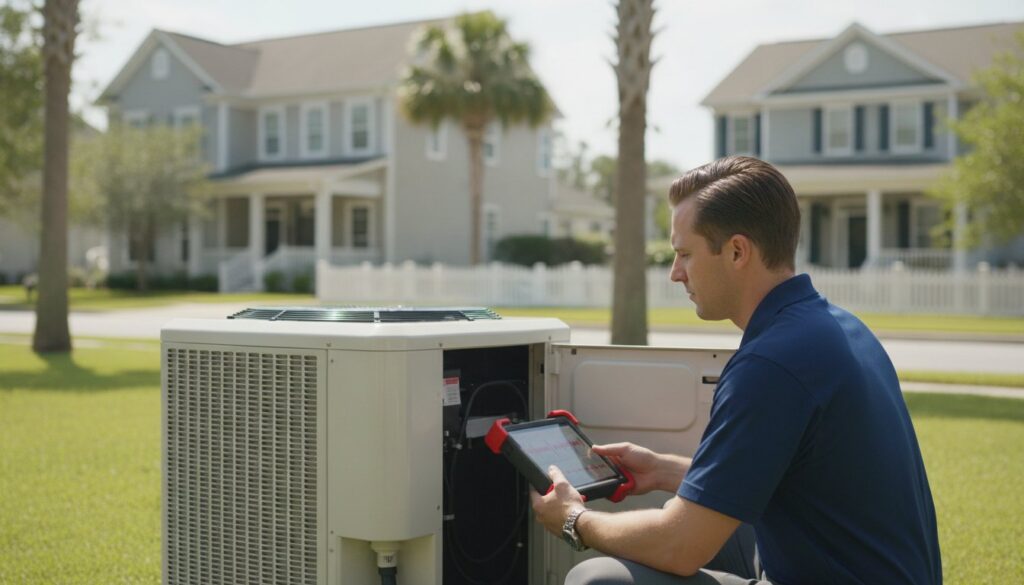
How does a technician actually “see” what is happening inside a sealed system? We use a suite of specialized tools that turn invisible symptoms into actionable data. While many homeowners are familiar with annual pre-season check-ups, a diagnostic visit goes much deeper. We utilize thermal imaging cameras to spot duct leaks and electrical hotspots hidden behind your drywall. This non-invasive approach allows us to find the source of your discomfort without tearing into your home’s structure. If you suspect your system is struggling, a professional hvac system diagnostics charleston can reveal exactly where the efficiency is being lost.
Beyond thermal imaging, we rely heavily on manifold gauges and electrical multimeters. These tools measure the “vital signs” of your unit. By testing the electrical load of your compressor and fan motors, we can often predict a failure before it actually happens. This is especially important for Charleston homeowners who want to avoid a total breakdown during a record-breaking heatwave. Identifying a motor that is drawing too much amperage today can save you from a much more expensive emergency repair tomorrow.
Testing the Refrigerant Circuit and Airflow
A major part of the diagnostic process involves measuring “superheat” and “subcooling.” These terms describe the temperature changes of the refrigerant as it moves through your system. If these numbers are off, your system is overstressed, which leads to higher energy bills and a shorter equipment lifespan. We also perform static pressure testing. Think of this as checking your system’s “blood pressure.” If the static pressure is too high, your ductwork might be “strangling” your unit. In many Charleston homes, what looks like a mechanical failure is actually just an airflow issue caused by poorly designed or clogged ducts.
The Impact of Salt Air and Coastal Humidity
Living in Mount Pleasant or downtown Charleston means your HVAC unit faces a unique threat: salt air. This coastal environment accelerates “coil pitting,” where tiny holes form in your copper lines and lead to refrigerant leaks. During a diagnostic, we specifically look for signs of galvanic corrosion. This occurs when the salt in our air reacts with the different metals in your unit, causing them to break down prematurely.
If your home is near the water, scheduling a thorough evaluation is the only way to ensure your system can still handle Charleston’s intense summer humidity. We don’t just check if the air is cold; we measure the system’s capacity to remove moisture, which is the real key to indoor comfort in the Lowcountry.
Interpreting Your Diagnostic Results: Repair, Replace, or Tune-Up?
Once the technical data is gathered, the next step is translating those readings into a clear plan for your home. This is where professional hvac system diagnostics charleston provide the most value. Instead of guessing, you have hard evidence to help you decide the best path forward. Sometimes, the results show that a major mechanical failure isn’t the culprit at all. A simple, thorough tune-up or a small electrical adjustment might be all that’s standing between you and a comfortable home.
How do you know when a repair is no longer worth the investment? We often recommend using the “Rule of 5,000” as a simple math framework. You multiply the age of your system by the cost of the repair. If the total exceeds 5,000, it’s usually more cost-effective to consider a replacement. For example, a 10 year old unit requiring a $600 repair equals 6,000. In this case, the “Efficiency Gap” is likely too large to ignore. This gap represents the extra money you’re spending on monthly bills compared to what a modern, high-efficiency unit would cost to run.
The Decision Matrix: Repair vs. Replacement
Choosing between a fix and a new unit depends on which component has failed. Wear and tear parts like capacitors or contactors are routine fixes that keep an older system going. However, a critical failure in the compressor or a severely corroded evaporator coil often signals the end of a unit’s lifespan. To help you navigate these choices, you can review our hvac repair vs replacement guide for a deep-dive into the specific criteria we use to protect your budget.
Long-Term Savings Through Accurate Diagnostics
Accurate hvac system diagnostics charleston don’t just solve today’s emergency; they prevent tomorrow’s headache. Identifying a small refrigerant leak now can prevent a sudden emergency furnace repair in Mt. Pleasant during a winter cold snap. These diagnostics also allow us to optimize your system for better SEER2 ratings. When you understand your system’s health, you can see if upgrading to high efficiency hvac charleston is the right move for your long-term energy savings. We always encourage homeowners to evaluate maintenance proposals carefully to ensure they are getting a solution that fits their specific needs and the unique climate of the Lowcountry.
When to Schedule Your Charleston HVAC Diagnostic: Warning Signs
Your air conditioner often whispers before it screams. For many homeowners, the first sign of trouble isn’t a total breakdown, but a subtle shift in how the home feels or sounds. Catching these early signals through professional hvac system diagnostics charleston can be the difference between a simple part replacement and a catastrophic system failure during a heatwave. If you find yourself constantly nudging the thermostat lower without feeling any relief, your system is trying to tell you something is wrong.
Mechanical distress usually announces itself through sound. Do you hear a sharp squealing when the unit kicks on? That often points to a slipping belt or a failing motor bearing. Grinding or banging noises are even more urgent, as they typically suggest a loose component is physically damaging the internal housing. While some homeowners hope these sounds will simply go away, they almost always lead to a more expensive repair if left unaddressed. Professional HVAC diagnostics can pinpoint whether that noise is a minor adjustment or a sign of a failing compressor before the unit quits entirely.
Short-cycling is another major red flag. This happens when your unit turns on and off every few minutes without ever completing a full cooling cycle. This constant starting and stopping puts immense strain on the electrical components and kills your energy efficiency. If your monthly power bills are spiking despite no change in your habits, your system is likely working twice as hard to do half the work.
Sensory Signs: What You Hear, See, and Smell
Sometimes the evidence is right in front of you. Have you noticed a musty, locker-room odor coming from your vents? This is often called “Dirty Sock Syndrome,” and it usually indicates that bacteria and mold are growing on your evaporator coil. Beyond the smell, keep an eye out for visual cues like ice forming on the copper refrigerant lines or water pooling in the drain pan. Ice is never normal on an AC unit; it’s a symptom of either a refrigerant leak or a severe airflow restriction that needs immediate investigation.
Performance Issues in High Humidity
In Charleston, temperature is only half the battle; humidity is the real test of your system’s health. If the air inside your home feels “sticky” or heavy even when the thermostat says it’s 72 degrees, your system has lost its dehumidification capacity. You might also notice uneven cooling, where the kitchen is freezing but the bedrooms remain uncomfortably warm. These performance gaps often signal that your ductwork or refrigerant levels are compromised. If you’re experiencing a total loss of cooling, don’t wait for the indoor temperature to hit 85 degrees. You can reach out for AC repair Mount Pleasant SC to restore your comfort quickly.
If any of these symptoms sound familiar, the best move is to act before the next major temperature spike. You can schedule a comprehensive diagnostic today to get a clear, honest assessment of your system’s health and avoid the stress of a sudden summer breakdown.
Frequently Asked Questions
How much does an HVAC diagnostic cost in Charleston?
Diagnostic fees in the Charleston area typically cover the technician’s time, travel, and the use of specialized testing equipment. While industry averages exist, exact pricing varies based on the company’s service standards and the complexity of the system. We recommend asking for a clear explanation of what is included in the evaluation before the technician arrives. This ensures you know exactly what you are paying for when investigating performance issues.
Is a diagnostic fee waived if I choose to do the repair?
Whether a diagnostic fee is applied toward the final repair cost depends on the specific service provider’s policies. Some local companies in the Lowcountry offer this as an incentive, while others keep the fees separate to cover the professional labor of the investigation itself. It is always best to clarify this during the initial scheduling call so there aren’t any surprises on your final invoice after the repair is completed.
How long does a professional HVAC diagnostic take?
A comprehensive diagnostic visit usually takes between 45 and 90 minutes. This timeframe allows the technician to perform a full system audit, including checking refrigerant levels, testing electrical components, and evaluating airflow. If your system has multiple zones or hidden issues in the ductwork, the process might take a bit longer. We take the time needed to ensure we find the actual root cause of the problem rather than just treating symptoms.
Can I perform my own HVAC diagnostics to save money?
While homeowners can perform basic checks like changing filters, professional hvac system diagnostics charleston require specialized tools and training. Attempting to test high-voltage electrical components or refrigerant pressures without the proper equipment can be dangerous and may void your manufacturer’s warranty. A certified technician has the expertise to identify subtle signs of wear that an untrained eye might miss, preventing more costly failures. This expertise protects your home and your investment.
What is the difference between a diagnostic and a tune-up?
A tune-up is a preventative maintenance service performed on a functioning system to keep it running efficiently. In contrast, a diagnostic is a problem-solving investigation triggered by a specific issue, such as poor cooling or strange noises. Think of a tune-up like a routine physical and a diagnostic like an X-ray to find the cause of a specific pain. Both are essential for the long-term health of your HVAC unit in our humid climate.
Need a hand with this? Mount Pleasant Heating & Air Conditioning has served Lowcountry homes and businesses since 2007, with 24/7 emergency service.
Call (843) 714-0863 or request service online. Related service: HVAC repair.