


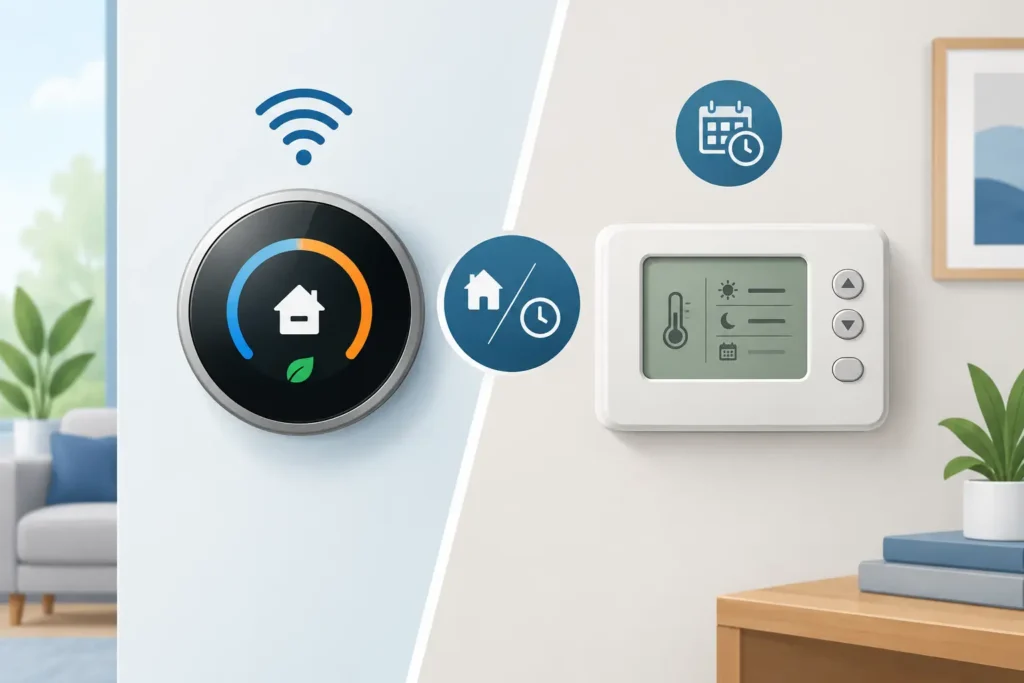
When the Lowcountry heat settles in, a thermostat is more than a small control on the wall. It determines whether your home stays comfortable without running your HVAC system harder than necessary. In the smart thermostat vs programmable thermostat decision, the right answer comes down to your schedule, your equipment, and how much control you want over your home’s comfort.
A programmable model can be a dependable, cost-conscious upgrade for many households. A smart thermostat offers more automation and remote access, but it is not automatically the better choice for every system or homeowner. Knowing the difference can help you invest wisely and avoid a thermostat that adds complications instead of comfort.
What a Programmable Thermostat Does Well
A programmable thermostat allows you to set temperature changes based on a repeating schedule. For example, you might set the air conditioning to ease back while everyone is at work or school, then return the home to a comfortable temperature before the family arrives.
Most models offer daily or weekly schedules. You choose the times and temperatures, and the thermostat follows those instructions without needing Wi-Fi, a phone app, or an account. Once it is set correctly, it is simple, predictable, and effective.
That simplicity is its biggest advantage. Homeowners who keep regular hours often do not need advanced learning features. A well-programmed thermostat can reduce unnecessary runtime while maintaining comfort when the home is occupied.
Programmable thermostats also tend to cost less up front. They are a practical fit for rental properties, second homes with predictable use, or homeowners who prefer controls that work without internet service. They generally have fewer setup requirements and fewer technology-related issues over time.
The trade-off is that the thermostat only knows the schedule you give it. If you leave work early, take a weekend trip, or stay out later than planned, it will not automatically adjust unless you change the settings yourself. Many homeowners eventually stop updating their schedules, which limits the savings they expected.
How Smart Thermostats Go Further
A smart thermostat connects to your home’s Wi-Fi network and can be controlled through an app. That remote access is valuable when you are away from home, returning from a trip, or simply want to adjust the temperature without getting off the couch.
Many smart models can also use occupancy sensors, phone location data, weather information, and past usage patterns to make temperature adjustments. Some learn when your household is typically home and away. Others provide energy reports that show how often your HVAC system runs and when setting changes may save energy.
For a busy household, that flexibility can be useful. If a workday changes unexpectedly, you can adjust the thermostat from your phone rather than cooling an empty house for hours. If you own a vacation property or travel often, remote monitoring can offer added peace of mind. Some models can even send alerts when indoor temperatures rise or fall outside a selected range.
Smart thermostats are not just about convenience. Used thoughtfully, they can reduce waste by avoiding full heating and cooling when no one is home. However, actual savings depend on the home, the HVAC equipment, insulation, thermostat settings, and whether the household uses the features consistently.
Smart Thermostat vs Programmable Thermostat: Key Differences
The difference is not that one controls temperature and the other does not. Both can schedule your comfort and help reduce unnecessary HVAC operation. The real distinction is how much automation, access, and system feedback you receive.
A programmable thermostat follows a fixed plan. A smart thermostat can adjust that plan based on changing conditions, depending on the model and settings. Smart models also provide app-based controls, while most programmable models are adjusted at the wall.
That added functionality comes with a higher purchase price and more installation considerations. Many smart thermostats need a common wire, often called a C-wire, to provide steady power. Some homes have one already. Others need an adapter, rewiring, or a different thermostat choice. Compatibility can also be more involved with heat pumps, multi-stage systems, zoning equipment, humidifiers, dehumidifiers, and older HVAC systems.
A smart thermostat also relies on a stable Wi-Fi connection for its remote features. It will usually continue to control basic heating and cooling during an internet outage, but app access, alerts, and online features may be unavailable. Homeowners who prefer to keep home devices off a network may see that as a reason to choose a programmable model instead.
Which Thermostat Fits Your Home?
Choose a programmable thermostat if your household follows a consistent routine and you want a straightforward, lower-cost way to schedule temperature setbacks. It is especially sensible when you prefer physical controls, do not need remote access, or want to avoid Wi-Fi-dependent features.
A smart thermostat may be worth the added investment if your schedule changes frequently, you travel, or you want to monitor and adjust comfort from anywhere. It can also be a good option for homeowners who pay close attention to energy use and will use the reporting and scheduling tools provided by the app.
Your HVAC system should influence the choice as much as your lifestyle. A thermostat must be matched correctly to the equipment it controls. Installing an incompatible thermostat can cause issues such as short cycling, poor humidity control, loss of auxiliary heat functions, or uneven temperatures. Those problems can be frustrating in any home and particularly unwelcome during a Charleston-area summer.
For homes with a heat pump, multiple heating and cooling stages, ductless equipment, or a zoning system, professional guidance is often the safest route. The right thermostat can support the features your system already has. The wrong one can leave performance on the table.
Energy Savings Depend on Settings, Not Just Features
It is easy to assume a smart thermostat guarantees lower utility bills. It does not. A thermostat saves energy when it reduces heating or cooling during times that do not sacrifice your comfort.
In cooling season, raising the temperature modestly while the house is empty can reduce demand. In heating season, lowering it during extended absences can do the same. But extreme setbacks are not always the answer. In a humid coastal climate, allowing indoor temperatures to climb too high for long periods may make the home feel damp and force the air conditioner to work harder to recover comfort.
The best settings balance efficiency with humidity control and the needs of the people in the home. If you have pets, young children, older family members, or rooms that run warmer than others, those details matter. A thermostat is one part of an overall comfort system, not a cure for airflow problems, aging equipment, duct leaks, or poor insulation.
Installation Matters More Than Most Homeowners Expect
Thermostat replacement can look simple, but the wiring behind the wall is not always straightforward. Labeling may be outdated, wire colors are not a guarantee of function, and a system can have controls that are not obvious from the thermostat itself.
A qualified HVAC technician can verify compatibility before installation, inspect the wiring, configure the thermostat for the equipment, and test heating and cooling operation afterward. This is especially valuable when replacing a thermostat on an older system. A careful setup helps protect your equipment and ensures the new controls actually deliver the comfort you expect.
If your current thermostat is inaccurate, difficult to operate, or causing your system to cycle oddly, it is worth having the issue diagnosed rather than assuming a new device will fix it. Mt Pleasant Heating & Air can help homeowners determine whether a thermostat upgrade, a wiring correction, or a system repair is the practical next step.
A thermostat should make your home easier to live in, not give you another device to manage. Pick the level of control that matches your routine, have it installed correctly, and let your HVAC system do what it was designed to do: keep your family comfortable when the weather outside does not cooperate.