

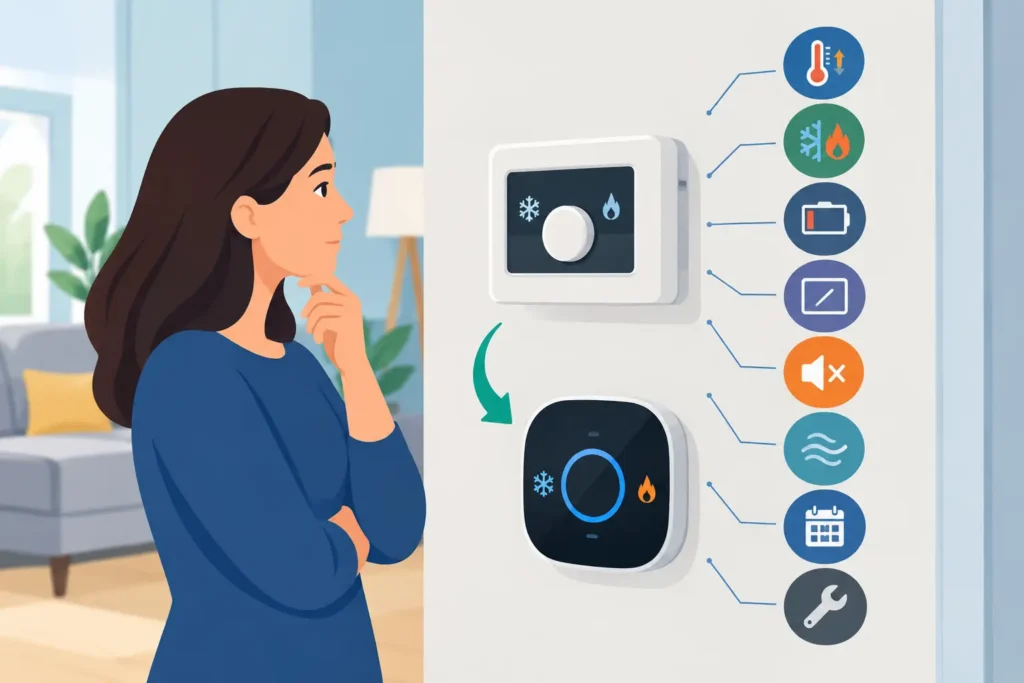
A thermostat can be a small part of your HVAC system with a big effect on daily comfort. If your home feels too warm upstairs, too cold at night, or strangely humid despite the AC running, you may wonder when to replace thermostat controls rather than blame the entire system. The right answer starts with a proper diagnosis. A thermostat problem can often be repaired or corrected, but an outdated or failing model may be costing you comfort, energy, and unnecessary service calls.
8 Signs It May Be Time to Replace Your Thermostat
1. The temperature on the screen does not match the room
A thermostat that says it is 72 degrees when the room clearly feels much warmer or cooler may have a faulty temperature sensor. Before assuming it has failed, check its placement. Thermostats located in direct sunlight, near a kitchen, beside a supply vent, or on an exterior wall can read the wrong temperature.
If the location is appropriate and the readings remain consistently off, replacement is often the practical choice. An inaccurate thermostat tells the heating and cooling system to run at the wrong times, which can make a well-functioning HVAC unit seem unreliable.
2. Your HVAC system turns on and off too often
Short cycling happens when an air conditioner, heat pump, or furnace starts, runs briefly, and then shuts down repeatedly. A thermostat with a damaged sensor, loose wiring, or calibration issue can cause this pattern.
That said, short cycling is not always a thermostat issue. It can also point to an oversized system, airflow restriction, refrigerant concern, clogged filter, or equipment repair need. A technician should identify the cause before replacing parts. The goal is to solve the actual problem, not simply install a new thermostat and hope for the best.
3. The system will not respond to thermostat changes
You raise the temperature, but the heat never comes on. You lower it, but the AC keeps running. When fresh batteries, correct settings, and a clean air filter do not resolve the issue, the thermostat or its connection to the equipment may be at fault.
A thermostat can lose its ability to communicate with the HVAC system because of worn internal components, corroded terminals, wiring damage, or a failed control board. The thermostat is only one possible cause, which is why professional diagnostics matter. Replacing a thermostat without checking the rest of the system can leave the original issue unresolved.
4. The screen is blank, dim, or malfunctioning
A blank display is an obvious warning sign, especially if new batteries do not restore it. Touchscreens that freeze, buttons that do not respond, flickering displays, and thermostats that randomly reset themselves also deserve attention.
Some smart thermostats require a steady common-wire connection to stay powered. If that connection was not installed correctly or has come loose, the thermostat may behave unpredictably. In other cases, the unit itself has reached the end of its useful life.
5. Your thermostat is more than 10 years old
There is no universal expiration date for every thermostat. A simple, well-maintained programmable model may work for many years, while an older unit with mechanical parts may lose accuracy sooner. Still, a thermostat that is 10 years old or older is worth evaluating during a maintenance visit.
Older models generally offer less precise scheduling, fewer humidity controls, and fewer options for managing energy use. If you are already replacing an aging air conditioner, heat pump, or furnace, upgrading the thermostat at the same time can help the new equipment operate as intended.
6. Your energy bills rise without a clear explanation
A sudden utility increase can have many causes, including duct leaks, a dirty outdoor coil, aging equipment, poor insulation, or unusually hot weather. In Mount Pleasant and Charleston, long cooling seasons and high humidity can make those increases especially noticeable.
But a thermostat that misreads temperatures, ignores schedules, or causes excessive runtime can add to the problem. If your usage habits have not changed and your home is not as comfortable as it should be, have the thermostat and HVAC system checked together.
7. Your current thermostat cannot support your comfort needs
Sometimes the answer to when to replace thermostat equipment is not failure. It is capability. A basic thermostat may be operating normally but still fall short for your household.
For example, a newer thermostat may provide better scheduling for a family with changing routines, remote access when you travel, or improved compatibility with a variable-speed heat pump. Some models can also work with indoor air quality accessories and humidity controls. In coastal South Carolina, humidity management can make a noticeable difference in how comfortable your home feels at the same temperature.
The upgrade should fit your equipment and your habits. More features are not automatically better. A complicated thermostat that no one in the household wants to use may not deliver the savings or convenience you expected.
8. You have made repeated adjustments with no improvement
If you are constantly changing settings to chase a comfortable temperature, it is time to stop guessing. One room may be uncomfortable because of thermostat placement, but it may also have an airflow, ductwork, insulation, zoning, or equipment issue.
A trained HVAC technician can test the thermostat, inspect wiring, verify system operation, and evaluate whether the thermostat is controlling the equipment correctly. This is particularly valuable in larger homes, homes with additions, and properties with multiple HVAC systems. A replacement may be the right solution, but only after the system has been evaluated as a whole.
Before Replacing a Thermostat, Check the Simple Things
A few basic checks can rule out easy fixes. Confirm that the thermostat is set to heat or cool rather than off, and make sure the selected temperature calls for the system to run. Replace batteries if your model uses them. Check that the circuit breaker has not tripped, and replace a heavily clogged air filter.
Also review the schedule. Many programmable and smart thermostats follow an automatic setback schedule that homeowners forget was activated. If the system changes temperature at the same time every day, the schedule may be doing exactly what it was told to do.
Do not remove thermostat wiring or bypass controls if you are unsure of the setup. Low-voltage wiring is generally straightforward for a professional, but incorrect connections can damage equipment controls or create a difficult-to-diagnose issue.
Choosing the Right Replacement Thermostat
The best replacement depends on the HVAC equipment in your home. Conventional central systems, heat pumps, dual-fuel systems, ductless mini-splits, and multi-stage equipment can require different thermostat configurations. Heat pumps especially need compatible controls to manage auxiliary heat correctly.
A standard programmable thermostat is often a dependable, cost-conscious choice for homeowners who want reliable scheduling without app-based features. A smart thermostat can be useful for homeowners who want remote control, energy tracking, or flexible schedules. For high-end systems with variable-speed operation, a manufacturer-compatible communicating thermostat may provide the best performance, though it usually costs more and should be installed correctly.
Professional installation also helps ensure the thermostat is mounted in the right location and configured for your specific equipment. That configuration matters as much as the thermostat itself. Incorrect settings for staging, heat pump operation, fan control, or cycle rates can reduce comfort and efficiency.
When a Thermostat Issue Needs Prompt Service
Call for service promptly if your system will not heat or cool during extreme weather, keeps running without stopping, trips breakers, produces burning odors, or short cycles repeatedly. Those symptoms can involve more than the thermostat and may put added strain on expensive HVAC components.
Mt Pleasant Heating & Air can diagnose thermostat and system concerns without rushing homeowners toward a full equipment replacement. Whether the fix is a wiring repair, calibration adjustment, compatible thermostat installation, or a larger HVAC repair, the right diagnosis protects your comfort and your investment.
A thermostat should make comfort feel automatic, not turn it into a daily guessing game. If yours is giving inconsistent readings or struggling to control your system, a focused inspection can provide a clear answer and help keep your home comfortable through every season.